
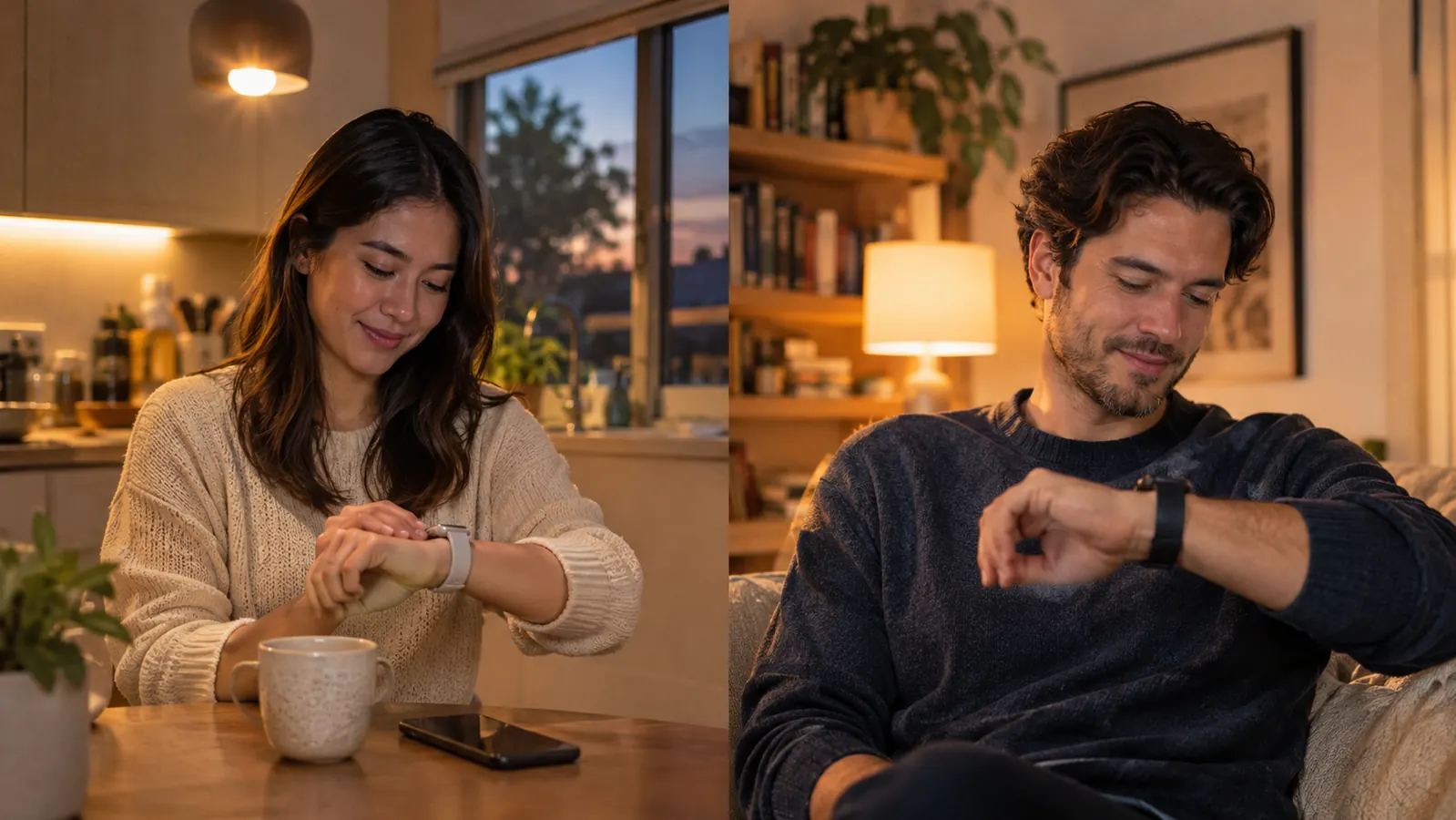
I bought the TOTWOO touch bracelets eighteen months ago for an anniversary I could not be in the same room for. Daniel was in Portland. I was in San Antonio, three weeks into a run of twelve-hour ER shifts, and the thing I wanted to give him was not really an object. It was an interruption. Something that would land on his wrist in the middle of a Tuesday and tell him I was thinking about him without a text, a call, or a two-hour time zone calculation.
So I ordered a pair. What arrived was two stainless steel wristbands on braided cord, one engraved with a sun and one with a moon, that pair through the free TOTWOO app and then buzz when the other person taps theirs. Eighteen months later, mine is on my wrist more days than not and Daniel's has not come off. I like them. I also think the listing oversells what a buzz can do, and there are a few things about living with them that I would want to know before I spent my own money again. That is what this is.
The Quick Verdict
A small, well made pair that does exactly one thing: it lets you reach across two time zones without a screen. Worth it for a daily signal. Not worth it if you want it to carry a conversation.
Amazon Check Today's Price →The buzz that says you are on my mind, without a text
The TOTWOO Sun and Moon set pairs through a free app, wears like ordinary jewelry and asks almost nothing of you. It has survived eighteen months of hospital shifts on my wrist and a Portland winter on his.
Amazon Check Today's Price on Amazon →How I've Used It
Daniel and I have been together four years, three of them long distance. He is a civil engineer, I am a nurse, and the geography is what it is: San Antonio to Portland, two hours apart on the clock, a flight that eats most of a day once you count the airport on both ends. We see each other about every six weeks, four days at a time, and we alternate who flies. The bracelets came in for our anniversary in May, eighteen months ago. I wear the Sun. He wears the Moon. That was less a romantic decision than a coin flip.
My routine with it is boring, which is the highest compliment I can pay a piece of jewelry. I put it on with my scrubs. Somewhere in the middle of a shift, usually when I am walking between the ER and the break room with my hands finally empty, I press mine for a second or two. Two hours behind me, Daniel's morning is starting. He taps back when he gets a minute. Some days that is the entire conversation, and on the bad days it is the only one I have time for.
The visits have their own rhythm with it. I fly out on a Thursday, land in Portland in the evening, and for four days the bracelets do nothing at all, because we are in the same kitchen. We both still wear them. Then I fly home, and the first buzz after a visit lands about six hours later, somewhere over the middle of the country, and that one always gets me.
One Tuesday in February makes the case better than any paragraph I could write. I picked up a double after a call-out, my third twelve in four days, and by hour ten I was standing in the supply room counting gauze because it was the only task left that did not require me to think. I pressed my wrist twice without deciding to. Four minutes later it buzzed back. Daniel was in a parking garage in Portland on his lunch break. Neither of us sent a text for another five hours. That exchange is the product, in one scene, and it cost me about two seconds.
What the Buzz Actually Does
Here is the thing nobody tells you about a touch bracelet: it is not a message. There is no way to send anything but the tap itself, and as far as I can tell the tap is the same every time. One buzz means the same as one buzz. Somewhere around month two we tried to make it a code, sun tap once for good morning, twice for call me when you can. It lasted a week. When you are tired enough you press the thing and you forget how many times you pressed it, and then you and your partner are having a small argument about whether a buzz meant 'I love you' or 'my phone is dead, please call.'
Once we stopped trying to make it a telegraph, it got useful. What it actually does is let one of us reach the other during a stretch of time when a phone is not an option. I cannot look at my phone on a shift. I can press my wrist for two seconds while I am washing my hands. That is the whole value, and it is a real value, but it is smaller than the listing implies. It is a knock on the wall between two apartments. It is not a conversation through the wall.
There is a second thing it does that I did not expect to care about: it makes Daniel present in a room he is not in. I will be charting at nine at night and feel the buzz and know, without checking anything, that he is thinking about me at seven his time. You cannot act on that information. It is closer to a mood than a message. Eighteen months in, that mood is the reason I still wear it.
I have also learned what it does badly. On a loud floor, with gloves on and a monitor alarming behind me, I miss it maybe one time in five. There is no way to check whether you missed one, which I have decided is a feature rather than a flaw, because the alternative is standing in a corridor refreshing a wrist like a phone. Daniel misses it far less often, because his office is quiet. If you are the one in the quiet room, you will get more out of this than the one on the floor.
I cannot look at my phone on a shift. I can press my wrist for two seconds while I wash my hands. That is the whole value, and it is smaller than the listing implies.
Battery, Charging, and the Shift I Missed
The bracelet charges on its own small cable, and I keep that cable on the kitchen counter next to the coffee maker, which is the only reason I remember it exists. Every few days it goes on the cable while I make dinner. That has been enough to keep it alive through a work week without any drama.
I did forget once, before a shift, and it died mid-shift. That is the closest thing to a real problem I have had with it in eighteen months and it was entirely my own fault. What surprised me was how much I noticed. Around hour nine I reached to tap it and got nothing back, and I spent the rest of the shift half convinced something was wrong on the other side of the country. It was not. The battery was dead. Daniel had no idea, because there is no way for the bracelet to tell him that my side went dark.
So budget for the cable. It is one more thing to charge, which is the least romantic sentence in this review and also the most honest one. If you are the sort of person whose phone dies at four in the afternoon, you are going to be the sort of person whose bracelet dies on a Tuesday.
On the Wrist: Fit, Comfort, and Gloves
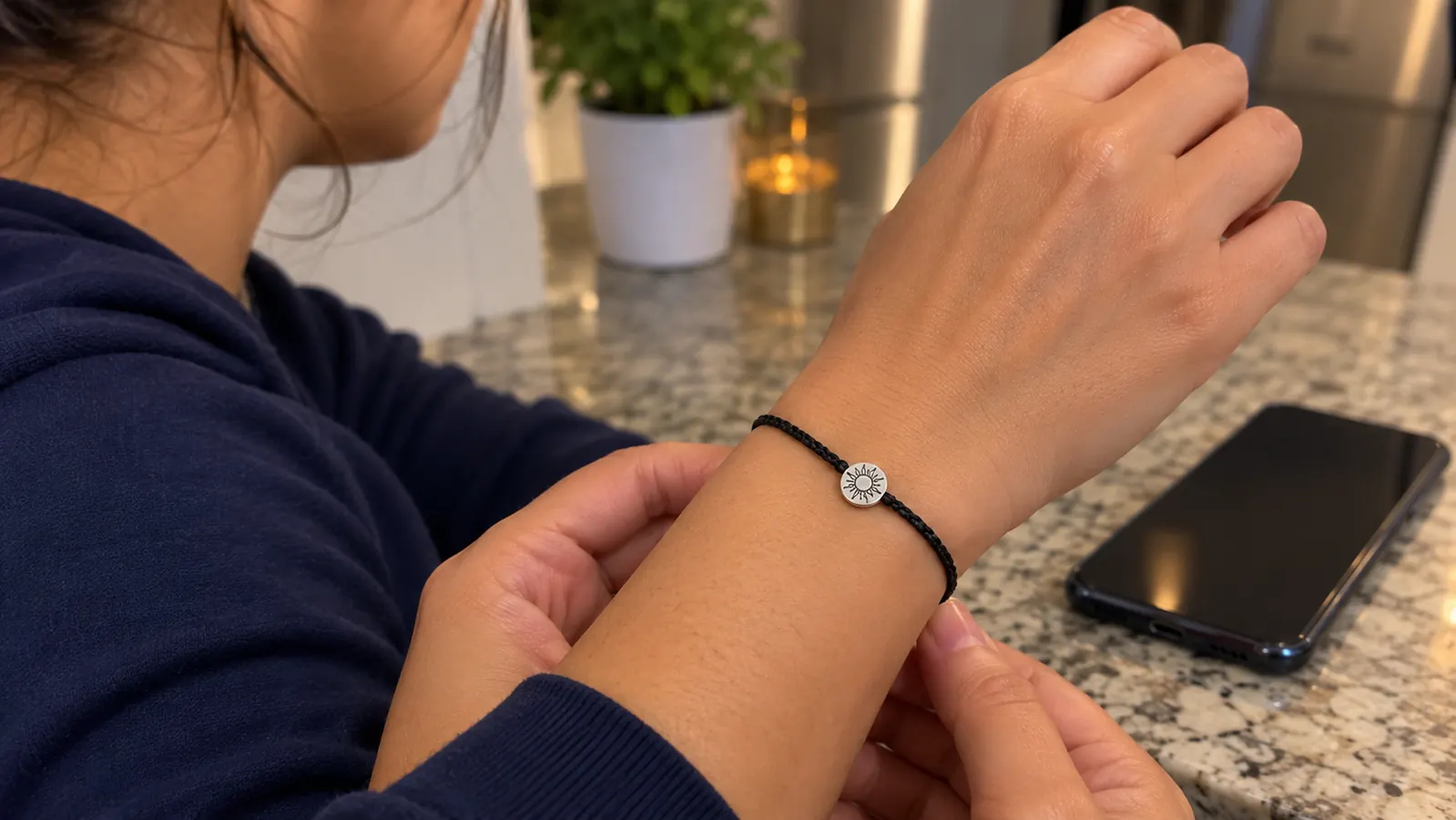
The bracelet is a wristband on a braided cord with an engraved stainless steel charm, sun on one, moon on the other. The listing gives one size and an item length of five inches. Mine sat a little loose for the first week and then I stopped noticing it entirely, which is what you want from something you wear to work. I take it off for showers and put it back on with wet hands without thinking about it.
One size is a real limitation and I want to be straight about it. My wrists are on the smaller side and the cord has never once felt like it was going anywhere. Daniel's forearms are the size of my calf from years of site visits, and his sat snug from day one without a word of complaint. What neither of us can tell you is how it sits on someone in between, because the listing offers one size and the fit comes down to how a braided cord happens to land on your wrist.
The one place it gets awkward is the hospital. Gloves go over it or they do not, and I have had a pair of gloves catch on the charm exactly twice in eighteen months. If you wear gloves for a living, expect to either push the bracelet up your arm or take it off before a sterile procedure. Neither is a deal breaker. Both are things I wish someone had told me in the first week instead of the fortieth.
Daniel wears his to bed and to the gym and has never mentioned it once, which from him is a five-star review. The charm is the only part that reads as jewelry. The cord reads as a festival wristband that never came off, and I mean that neutrally. Nobody at work has ever asked me what it is, which is either a sign that it is subtle or a sign that nurses have seen stranger things on a Tuesday.

Pairing, the App, and the Two Things I'd Change
Pairing runs through the TOTWOO app, which is free and does not ask for a subscription. Setup took me maybe ten minutes, most of it spent getting both bracelets awake at the same time. When Daniel set his up on his end over a video call, it took the same ten minutes and neither of us had to talk the other through it. Since then the app is something I open when I get a new phone and otherwise ignore, which is exactly how I want an app attached to a piece of jewelry to behave.
The first thing I would change is the silence when it dies. A tap that does not come back looks exactly like a partner who is busy, asleep, or annoyed with you. Eighteen months in, I default to the boring explanation. In the first three months, I did not, and I spent an embarrassing amount of a Sunday wondering whether something had happened in Portland when the answer was that Daniel had left his on the nightstand.
The second is range of expression. Everything is one buzz, and after a while the sameness wears a little thin. What saves it is that the buzz is not the whole system. It is one small channel sitting next to the phone calls, the cards on Sunday night, and the flight I book every six weeks. A bracelet that tried to be all of those things would be worse at all of them.
What I Liked
- The buzz reaches you without a screen, which matters in any job where a phone is not an option
- Engraved stainless steel charms on a braided cord have held up to eighteen months of daily wear and hospital hand washing
- Pairs through the free TOTWOO app with no subscription, and setup took about ten minutes on each end
- One size, one tap, one job, so there is nothing to configure wrong at eleven at night
Where It Falls Short
- It cannot carry information, so it will never replace a text message
- Charging every few days is one more cable on the kitchen counter
- When it dies mid-shift, your partner has no way of knowing your side went quiet
- The buzz is subtle, and on a loud floor with gloves on I have missed it
Who This Is For
This is for the couple who already talk and just want one more channel that does not involve unlocking anything. It is especially good if one of you works a job where your hands are busy and your phone is in a locker: nurses, teachers, line cooks, drivers, anyone on a floor or behind a wheel. It is also good for the partner who is bad at texting, because there is no composing involved and therefore nothing to overthink. And it is a genuinely good anniversary gift when you have already done the flowers and the dinner reservation from opposite sides of the country and want something that will still be on his wrist in March. At 4.2 stars across 508 reviews, most people land where I landed: it does what it says, and what it says is smaller than they imagined.
There is one more case worth naming, and it is the one that convinced me. We bought ours eighteen months out from a stretch where we already knew we would not see each other for eleven weeks, because of his project schedule and my shift rotation lining up badly. That is the worst version of this arrangement, eleven weeks with no flight in the middle of it, and the bracelets did the most work in exactly that window. If you are counting down to a long gap rather than living in a permanent one, this is the version of the gift that earns its place on a wrist.
Who Should Skip It
Skip it if what you actually want is to send words. A bracelet is not a messenger, and the people who leave one-star reviews of these things are almost always people who expected to type something. Skip it if you know you will resent charging one more device, or if your partner does not wear anything on their wrists and never will, no matter how good the intention behind it. And skip it if you are buying it to fix something. It is a knock on the wall. A knock is lovely. A knock does not repair a wall. What it does is make six weeks between visits feel like a shorter six weeks, and for that, eighteen months in, I would buy it again.
Six weeks between visits is a long time. This shortens it a little.
Free app, no subscription, one tap that lands two time zones away. Mine has been on my wrist for eighteen months and I still press it walking out of the ER at two in the morning.
Amazon Check Today's Price on Amazon →