
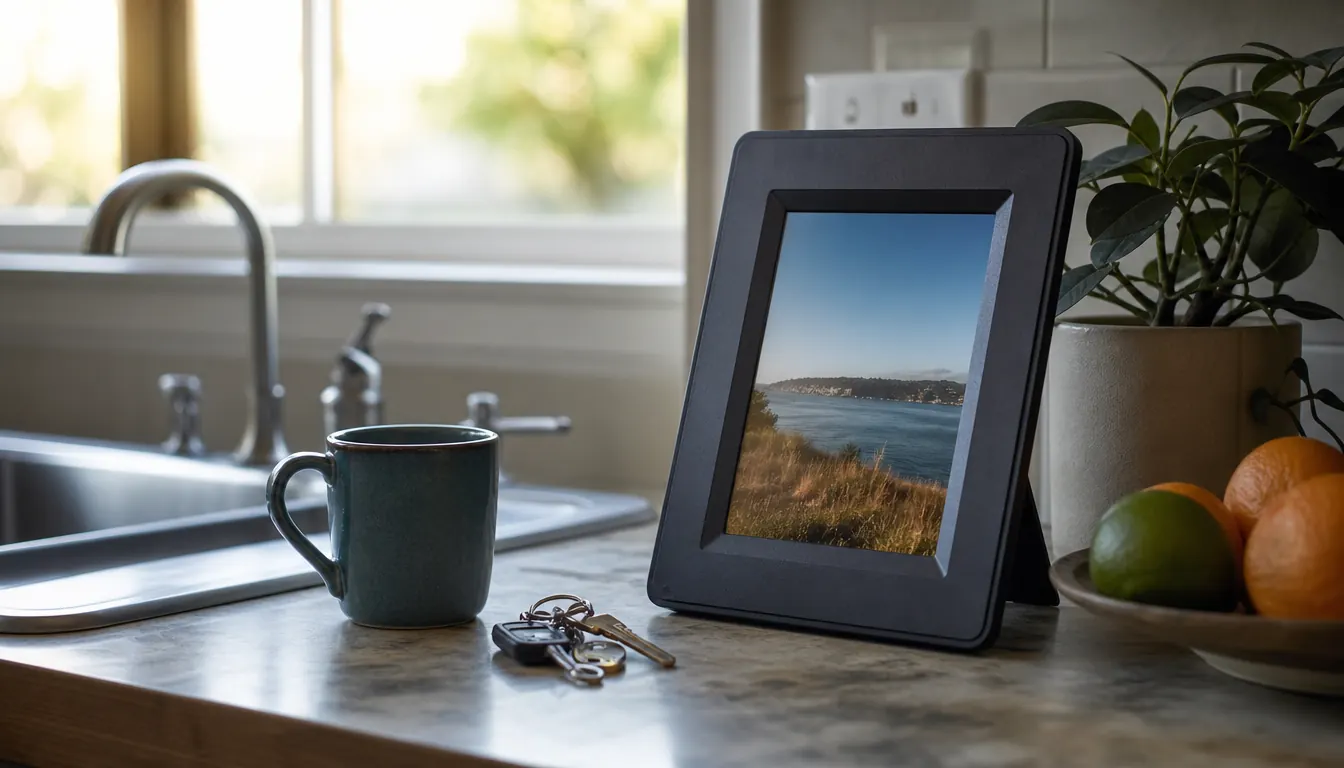
Daniel's kitchen counter in Portland was bare for the first two years of our long distance stretch. Not messy, bare. A coffee maker, a pile of mail he never opens, a blank wall behind it. My apartment in San Antonio is the opposite. Photos on the fridge, a print of the river walk taped by the door, a strip of booth pictures from our first trip shoved into the mirror frame. He is not the kind of person who thinks to fix that himself. So in March, for his birthday, I bought him an AURA Carver and preloaded it with thirty photos, a twelve second video, and a note I typed at two in the morning after a shift.
Eight months later it is still on that counter, and it has become the thing I look at when I want to know how he is doing. This review is written from the sending side, which is the side most frame reviews skip. I do not live with this frame. I send to it. Daniel is the one who walks past it a dozen times a day. So what follows is what I actually know: what setup took, what the photos look like from across a room, what it asks of me every month, and the parts that annoy me. The AURA Carver is a good frame and I would buy it again. It is not magic, and there are two things you should hear before you spend anything.
The Quick Verdict
Worth it. Ten minutes to set up, no monthly fee, and a screen that makes a bare kitchen look lived in. It needs an outlet, it needs Wi-Fi, and it will not tell you whether he looked.
Amazon Check Today's Price →He sees a new photo before his coffee finishes brewing
That is the whole pitch. I send from my phone on the walk home from the hospital, he sees it in Portland two hours later. Nothing to print, nothing to subscribe to, nothing for him to set up twice.
Amazon Check Today's Price on Amazon →How I've Used It
I want to be clear about the arrangement, because it changes what this review can tell you. The frame lives on Daniel's counter in Portland. I live in a one bedroom in San Antonio and work twelve hour shifts in an ER. Portland is two hours behind me, so when I clock out at seven at night, he is just getting home from work. I send photos from my phone: the walk home, the sunrise over the parking garage, a hospital vending machine at four in the morning, a bad plate of eggs I made on a Tuesday. Usually a few a week. Some weeks, none.
He does not send much back. That is not the frame's fault, that is Daniel. The one photo he sent me in eight months was of the counter itself, with the frame in it, to prove it was working. I appreciated the proof and found it very funny. What he does instead is mention things. A photo of the two of us at the coast came up while he was making coffee one morning and he called me about it before work. That is the actual return on this thing: not that he sends, but that the room has something in it worth remarking on.
I see the frame in person about every six weeks, for four days at a time, when one of us flies. So I have watched it in daylight, at night, from the couch, from the doorway, and from six inches away while squinting at a photo of my own face. That is more contact than most people get with a gift they handed over and left behind. It is also why I am not going to pretend I know what it is like to live with it every day. Daniel does. His summary, the one time I asked him to be useful about it: it is just there, and he likes that it is just there.
Setup Was One Video Call, Not a Project
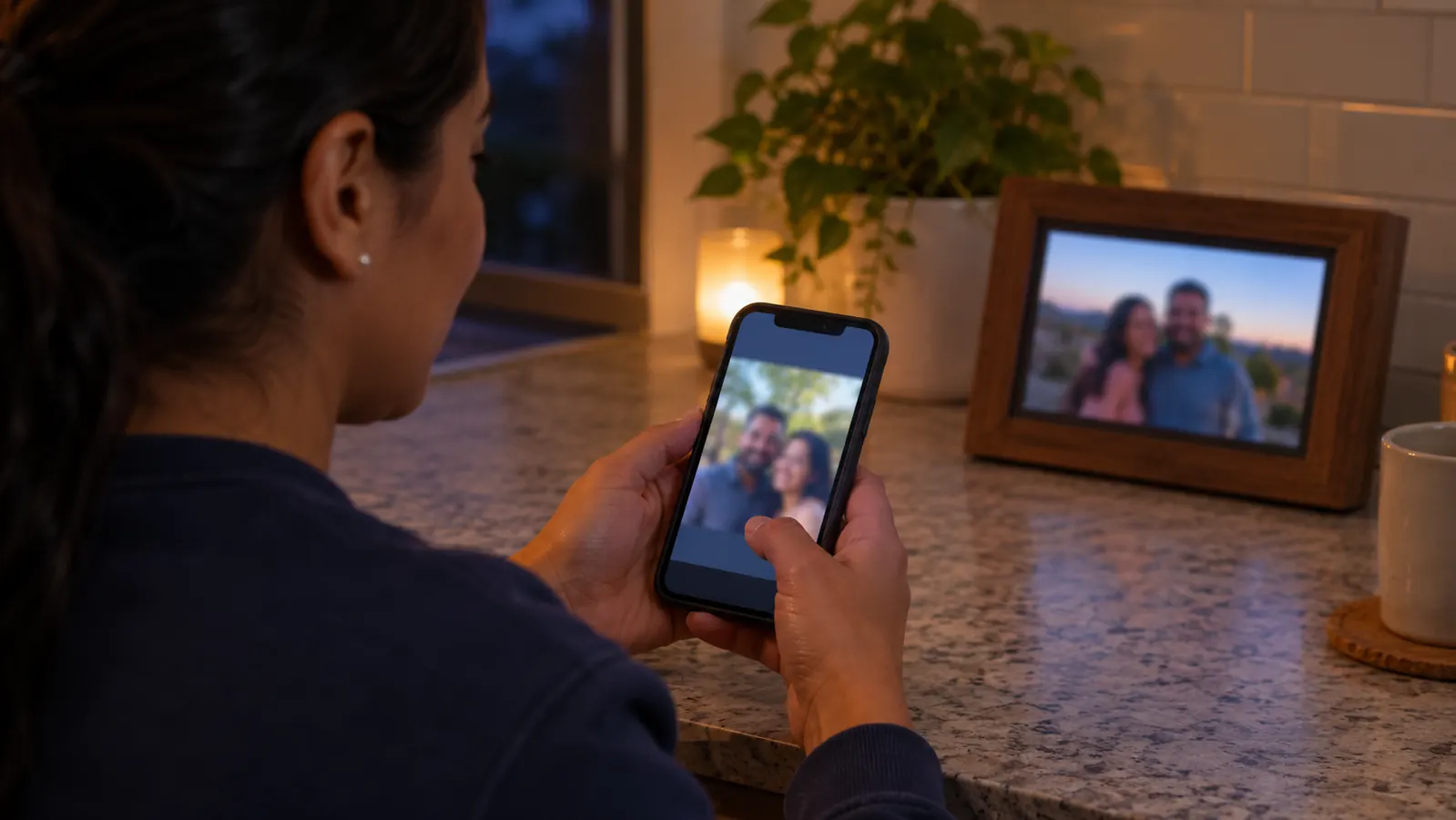
I had read enough frame reviews to expect a fight. Pairing codes, a dead account, a factory reset at eleven at night. None of it happened. Daniel plugged it in on the counter, downloaded the app, and got on a video call with me while he did it. I walked him to the code, he typed it, the frame found his Wi-Fi, and the photos I had already loaded started cycling while we were still talking. Ten minutes, most of it spent finding an outlet.
The outlet is the unglamorous part and I would not leave it out. The frame is corded. It is not going on a shelf across the room unless you are willing to run a cord or hide one, and it will not run on a battery because there is no battery. Daniel's counter had a plug behind the coffee maker, so it worked out. Before you buy for someone whose kitchen you have not stood in, ask them where an outlet is. That is a strange text to send. Send it anyway.
The preloaded part deserves its own paragraph. Before I handed the frame over, I loaded thirty photos, a short video from a trip we took in the fall, and a typed message that came up when he set it up. So the gift was not an empty screen and a promise to send things later. It was already full when he plugged it in. If you are buying this for someone far away and you will not be there when it arrives, do that. Twenty minutes of choosing photos turns a piece of hardware into something with your face on it before the wrapping is off.
What a Ten Inch Screen Looks Like From His Counter
The display is 10.1 inches at a 16:9 aspect ratio, inside a frame that measures about 10.1 by 12.7 inches. It takes up a little more counter than the number suggests. That is a small complaint and I am making it anyway, because I pictured something closer to a paperback and got something closer to a placemat. It still fits between the coffee maker and the wall. Just measure first if space is tight.
From six feet away it reads like a print. From across the room it reads like a window. The photos are sharp enough that I can tell when one is out of focus, which matters because half of what I send is taken while walking. Vertical phone shots get cropped to fit the wide screen, so a face near the top edge gets clipped. I shoot a little wide now when I know a photo is headed there. That is a me problem more than a frame problem, but nobody warned me, so I am warning you.
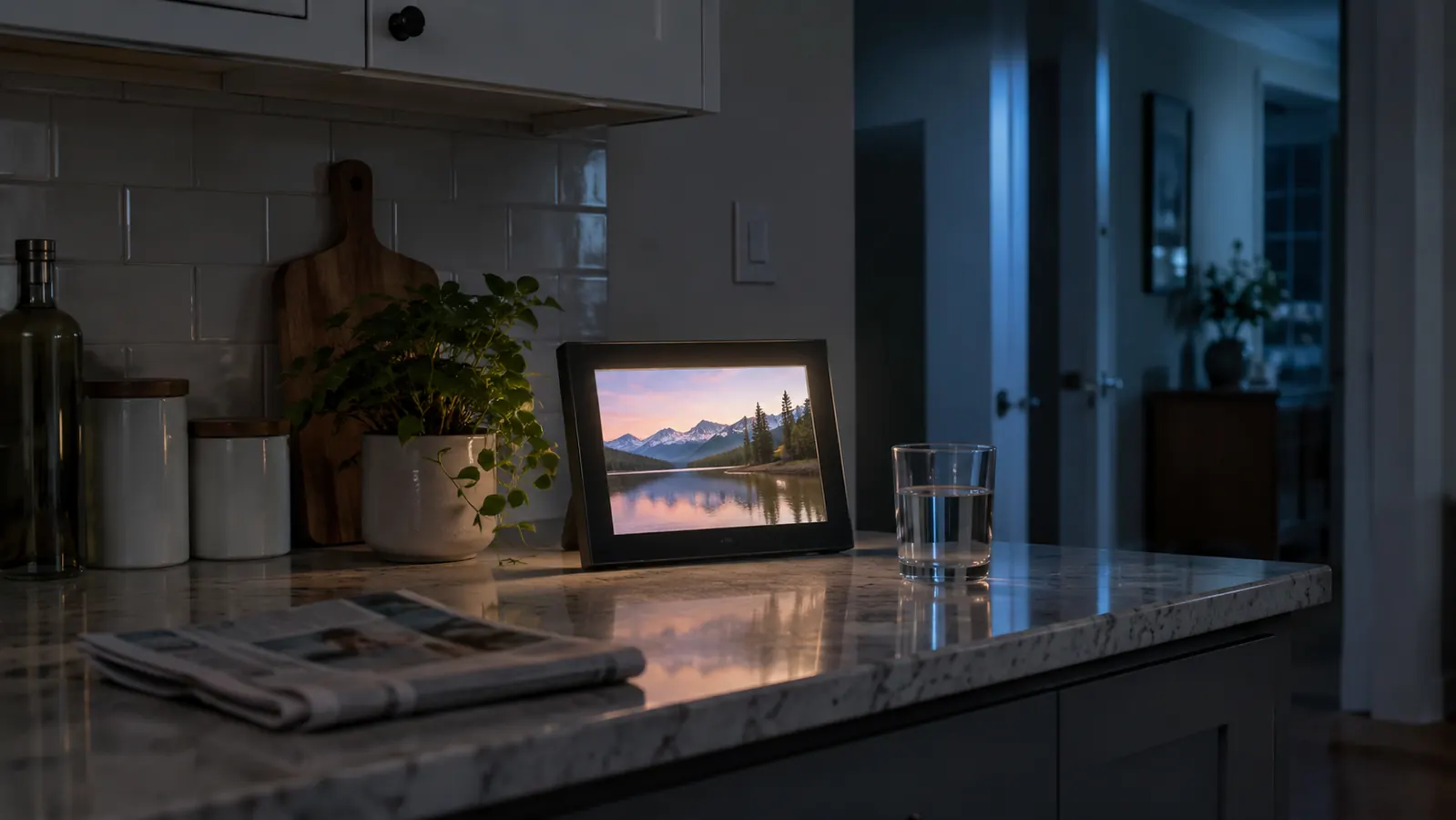
Light is the other half of it. His kitchen takes hard afternoon sun through a window over the sink and the screen still reads clearly. At night, with the overhead off, it is bright enough to work as a nightlight. He likes that. I would find it irritating if I slept in the same room as it, and I have said so to him. It is a screen. It glows. If you want something that disappears into a wall, this is not that.
The Detail I Did Not Expect to Care About
There is no subscription. I want to be careful with that sentence, because I have been burned by gear that is affordable once and rented forever after. Eight months in, I have never been asked to start a trial, upgrade a tier, or hand over card details to keep sending photos. The app is free, the frame keeps working, the photos keep arriving. When you are buying a present for someone else, that is the difference between a gift and a bill you forwarded.
It also means the frame does not turn into junk if I go quiet. If I have a bad stretch and send nothing for two weeks, it cycles what it already has. Daniel's counter still shows the coast trip, the river walk, and a photo of the two of us at the airport in February that I hate and he refuses to remove. Nothing expired. Nothing locked.
One thing about how it works in practice. Photos arrive as I send them. There is no inbox on his end, no approval step, no folder he has to sort through. That is the point of the thing, and it also means you should not send anything you would not want on a kitchen counter when his mother is standing there. I learned that one at a distance, which is the only comfortable way to learn it.
Where It Falls Short
The Wi-Fi requirement is real and I would not wave it away. His building's signal is fine. Mine is not, and there have been nights when my app sat on a spinner and the photo never landed. I sent it again in the morning and it went through. Nothing broke, nothing was lost, it was just slow and mildly infuriating at the end of a twelve hour shift. If the person you are buying for has weak internet, expect a little of that.
The bigger limitation is not technical. This frame makes his kitchen less empty. It does not make him less far away. There were weeks in July when I sent eleven photos and still felt like I was talking to a screen, because I was. It is not a substitute for the four day visits, and if you are buying it hoping it will patch a relationship that is already strained, it will not. It is a good object that carries your face into a room you are not standing in. That is worth a lot. It is not worth everything.
And there is no way to know whether he looked. No read receipt, no ping telling me he paused on one photo for a while. I have decided that is a feature. If that information existed I would check it hourly, and I have enough to do.
What I Liked
- Preloading photos, a video and a message means the gift arrives full instead of empty
- Setup was ten minutes over one video call, with no troubleshooting and no reset
- No subscription, no trial, no card details required to keep sending photos
- The 10.1 inch 16:9 screen is legible from across a kitchen in daylight
- Touchscreen display, so there is no remote to lose
- One year warranty
Where It Falls Short
- Corded only, so the frame needs an outlet exactly where you want it
- Needs a solid Wi-Fi signal to receive new photos
- Vertical phone photos get cropped to fit the wide screen
- The screen glows at night, bright enough to notice in a dark room
- No way to know whether a photo has been seen
Eight months in, I have never been asked to start a trial, upgrade a tier, or hand over card details to keep sending photos.
Who This Is For
Buy it if you are the one who sends. The frame is at its best when one person lives somewhere else with a phone full of ordinary things the other one is missing: the walk to the car, the bad eggs, a dog at the vet, the parking garage at sunrise. It suits partners in a long distance stretch. It suits a parent whose kid moved three states away. It suits anyone whose person lives in an apartment with blank walls, because that was Daniel exactly. It also suits the gift giver who wants something that keeps going after the birthday is over. Every photo I send is a small second gift, and I have sent a few hundred of them now.
The practical version: it is a good pick if the person receiving it will plug something in and leave it there, if there is an outlet within reach of the counter, and if you are willing to send photos a couple of times a week. Ten minutes of effort a week on your end keeps the whole thing alive. If that sounds like a chore, the frame will sit there cycling the same thirty photos I loaded in March, which is a sadder outcome than not buying it.
Who Should Skip It
Skip it if the spot where it would live has no outlet nearby, because there is no battery and no way around the cord. Skip it if the person getting it is not the type to plug in a device and leave it alone. Skip it if the internet where it is going is unreliable and you know that will bother you. Skip it if you want something that plays conversations rather than clips, because this is not a calling device. And skip it if you are buying it as a repair. A frame on a counter is a lovely thing. It is not a fix.
The counter in Portland has not been bare since March
Eight months, a few photos a week, no subscription, no fuss from him. If you have someone two time zones away and a phone full of ordinary days, this is the AURA Carver I would buy again.
Amazon See Today's Price on Amazon →