

Two lamps, two cities, one tap. That is the whole pitch, and both Friendship Lamp and LuvLink are selling it to the same person: someone who lives two hours or two flights away from the person they would rather be sitting next to.
Here is the short answer before the long one. I have owned the Friendship Lamp Classic set of two for two years. I have never owned a LuvLink. What I know about LuvLink comes from its listing, its reviews, and one evening in a friend's kitchen watching her set hers up while we ate takeout. Both lamps do the thing they promise. The difference shows up around week four, when the novelty is gone and the lamp either earns its spot on the nightstand or becomes a very small, very costly paperweight.
The compressed version: if you want one signal between two people and you want to stop thinking about it after setup, buy the Friendship Lamp. If you want a lamp that looks like decor and can stay lit in the room, look hard at LuvLink. If you want a lamp that will fix the distance, buy neither, because no lamp does that and both companies know it.
| Friendship Lamp (Classic set of 2) | LuvLink | |
|---|---|---|
| How you send a signal | Touch the top of the lamp, and the color goes to every lamp in your group | Touch the lamp, and their app carries the color to the other one |
| Setup | Friendship Lamps app plus a 2.4 GHz Wi-Fi network, done once | Their app plus Wi-Fi, done once |
| Colors | 256 colors picked in the app | Color picked in the app |
| Doubles as room light | No. The listing says plainly that it does not produce true white | Yes. It is designed to sit lit as a decor piece |
| Looks on a nightstand | Printed mosaic shade, reads like a device that has a job | Styled closer to a decor object in the product photos |
| People in the group | One group, unlimited compatible lamps | Built and marketed around a pair |
| What ships in the box | Two lamps, two manuals, one power cable | Varies by the set you choose, so read the box list |
A note on that table. I filled the LuvLink column from its listing and from my friend's set, not from a month of my own use. Where I could not confirm something, I left it out instead of guessing. A comparison built on guesses is how people end up with a lamp that will not talk to their network.
One thing I would flag before either purchase: a touch lamp is a poor apology gift. It works when it is a habit, and it sits there doing nothing when it is a gesture. If you are buying it to patch a bad month, book the flight instead. The lamp is for people who already talk every day and want one channel of that talking to be quieter.
Where Friendship Lamp Wins
The first win is the group. One Friendship Lamp group holds unlimited compatible lamps. That reads like a spec line until you are the person in the middle of it. Ours is two lamps, one in San Antonio and one in Portland, and two is all we need today. But when my sister finally gets her own place, she can join the same group without either of us buying anything new or re-pairing anything. A lamp built around a pair cannot do that, and a lot of people are buying for a parent or a best friend as well as a partner.
The second win is that the thing has exactly one job, and no opinions about it. The Classic is a touch switch, 256 colors, a cord, and a small tabletop footprint of 4.5 by 4.5 by 7.5 inches. That is the list. There is no feed to scroll, no streak to keep alive, no notification asking me to engage. I tap the top. Daniel's lamp turns the color I picked. He taps his. Mine turns blue. In two years the only maintenance it has needed was a ten-minute re-add after I replaced my router.
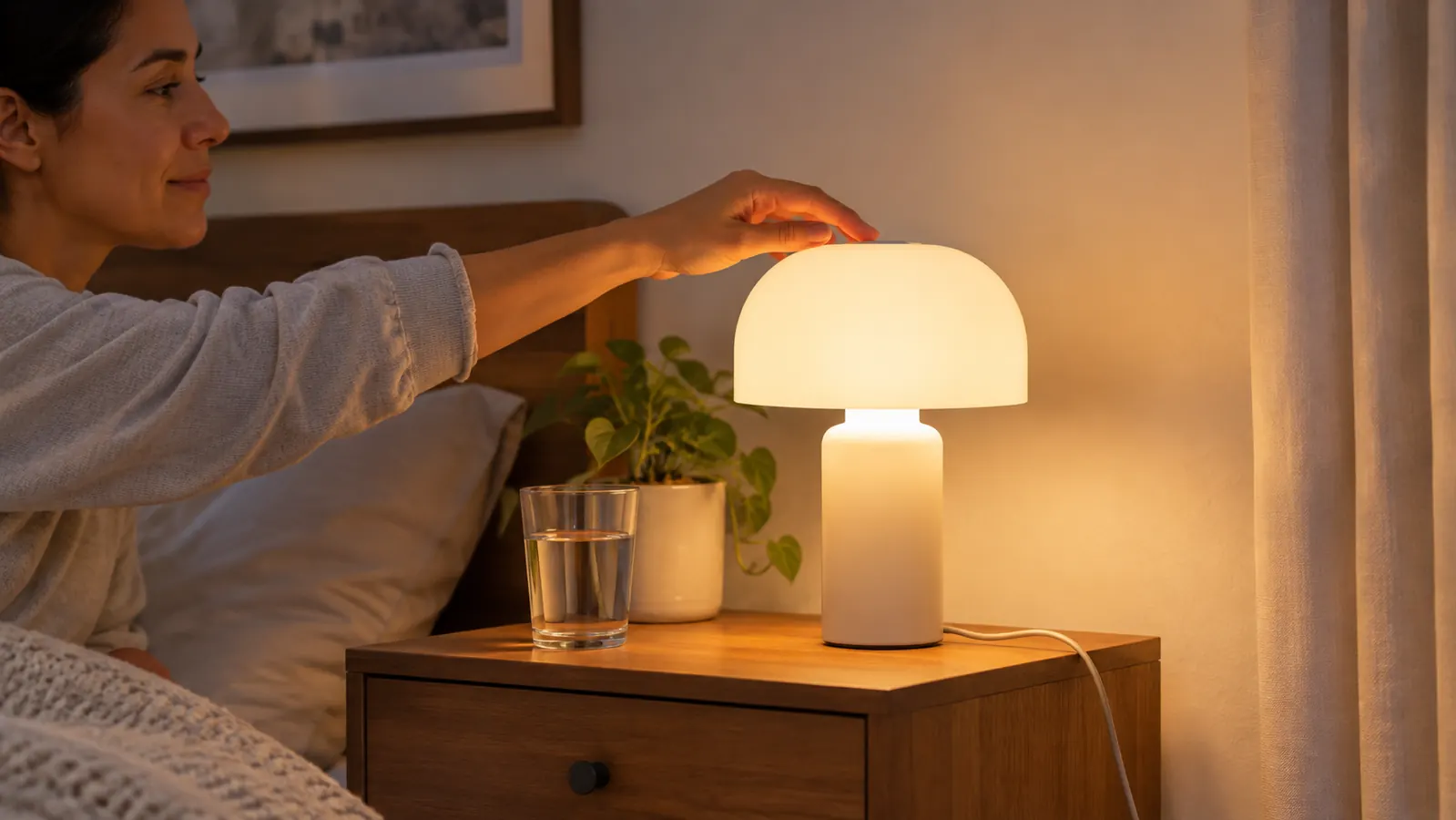
The third is physical, and it matters more than I expected. It weighs about 3 pounds, it sits on a tabletop, it runs a 5 watt LED on a cord, and it fits beside a phone and a glass of water without a negotiation. It is not waterproof, so if you were picturing a bathroom shelf, stop picturing that. Mine has not moved from the same square of nightstand in two years and does not need to.
The fourth is a track record I could actually check. The listing carries a 4.6 average across roughly 2,700 ratings. I read a lot of those before I bought, mostly the three-star ones, and the complaints were about Wi-Fi bands and about the light not being white. Both are true. Both are also stated in the listing. I would rather buy a lamp with honest limitations than one with a perfect score and no specifics.
Where LuvLink Wins
LuvLink wins the shelf. Pull up the product photos and you are looking at something styled to be seen, the way a small vase is seen. The Friendship Lamp Classic is not that. It has a printed mosaic shade and it reads like a device with a job, which it is, and there are rooms where that is exactly wrong. If the lamp is going on a console table in a space you actually decorate, or you are buying for someone whose apartment has opinions, LuvLink fits that room more easily than mine does.
The second win is light, and this is the one I would think hardest about. The Friendship Lamp Classic does not produce true white. Filimin says so plainly, in the same breath as the 256 colors, and after two years I can confirm it. This is a signal light. It is not a reading lamp, and it is not the lamp you want to be navigating toward at 3 am. If you want something that stays lit and warms a room while it also carries a color across the country, LuvLink is built for that and the Friendship Lamp simply is not.
That is a genuine trade, not a knock. Two lamps that both glow are not competing on glow. They are competing on what the glow is for, and one of them is for reading the room and the other is for reading your partner's evening.
One tap, two nightstands, nothing to open
The Friendship Lamp Classic set of two pairs once over 2.4 GHz Wi-Fi and then does nothing but glow. 256 colors, unlimited lamps per group, and a 4.6 average from about 2,700 ratings.
Amazon Check Today's Price on Amazon →Setup, and the One Network Setting That Trips People
Daniel set his lamp up in Portland while I watched on video, and the whole thing took about ten minutes, including the part where he held the lamp up to the camera to prove it had turned blue. That is the installation. You install the Friendship Lamps app, you put the lamp on a 2.4 GHz Wi-Fi network, you name it, you pick a color, and then you can ignore the app for months if you want to.
The 2.4 GHz part is where people get stuck. Most modern routers broadcast two networks, and phones prefer the 5 GHz one, so the app looks like it is failing when it is really just talking to the wrong band. I replaced my router last spring and the lamp dropped off. Re-adding it took about ten minutes and one round of me standing in the hallway holding my phone at chest height like that would help. It did help. I do not know why.
My friend's LuvLink setup looked like the same evening with a different logo. App, network, one lamp, then a second, then a test tap across the kitchen. If you can set up a smart plug, you can set up either of these. Neither requires you to be the technical person in the relationship, which matters more than any line on a spec sheet, because the person who ends up doing it is usually the one who cares less about gadgets.
What Two Years of Daily Tapping Actually Does
Our lamps have two jobs. The first is the end-of-shift signal. I work twelve-hour shifts in an ER in San Antonio and they rotate, so some nights I get home at 7:40 and some nights I get home at 11:40. Daniel is two hours behind me in Portland, which puts a late shift for me somewhere in the middle of his evening. I walk in, drop my bag, tap the lamp, and his nightstand turns rose pink. He knows I am through the door and safe before I have taken my shoes off.
The second job is goodnight. His lamp turns blue on my nightstand. Mine turns rose pink on his. That is the entire message. There is no text to compose and no tone to misread, which is the part I did not expect to value. After a bad shift I do not have sentences in me. I have one tap, and it says the thing.
Two years, one dropped Wi-Fi connection, ten minutes to fix, and the lamp has not been unplugged since.
What surprised me is that the novelty did not wear off so much as convert into routine. The lamp is not exciting in month thirty. It is load-bearing. When I fly to Portland for four days, the lamp does nothing at all, and I mean that as praise. Neither of us touches it, because the person is in the room. Then I fly home, and the first night back I tap it before I have unpacked, and the blue comes back.

What I Would Do Differently
I bought the Friendship Lamp two years ago as a Christmas present, and I set it up wrong in my own head. I thought of it as a gift for Daniel. It turned out to be a gift for the two of us, and the half I use is the half that matters most to me. I would buy it again in a November, and I would do the pairing together on a video call the way Daniel insisted on doing his, instead of mailing it and hoping for the best.
The other change is timing. Mine arrived in a December, which is a month when we already talk constantly, so it took a quiet stretch in February before the lamp found its job. If you buy one now, give it a month of ordinary weeks before you decide whether it is doing anything. Rituals take longer to form than a return window is open.
The Questions I Would Ask Before Buying Either
Before you pick a side, answer three things. First, what band is your Wi-Fi on, and do you know how to check. If you do not, find out before the box arrives. Second, does this lamp need to light the room, or only carry a signal. If it needs to light the room, the Friendship Lamp is out and LuvLink is the honest answer. Third, who is in the group. Two people is easy for any touch lamp. Two partners plus a parent plus a kid away at college is a different problem, and the unlimited group on the Friendship Lamp is doing real work there.
What I Liked
- Touch to send, with no app to open and no notification to check
- One group that holds an unlimited number of compatible lamps
- 256 colors under a printed mosaic shade that does not look like a smart speaker
- Set up once on 2.4 GHz Wi-Fi and then left alone for months
- 4.6 average across roughly 2,700 ratings, with the limitations stated in the listing
Where It Falls Short
- No true white light, so it is a signal light and not a reading lamp
- 2.4 GHz only, which means a 5 GHz network will not work
- Corded, tabletop only, and not waterproof
- Two lamps is the minimum purchase, so there is no inexpensive way to test the idea
- Nothing to do with it beyond tapping, which some people will find thin after a month
Who Should Buy Which
Buy the Friendship Lamp if the relationship runs on small daily signals and you want them wordless. If you want the end-of-shift ping, the goodnight, the two o'clock in the afternoon nudge without opening yet another app, this is the cleanest version of that I have found after two years of looking for one. It is also the version to buy if more than two people will ever be in the group, because that is where the pair-based lamps stop being able to help you.
Look at LuvLink if the lamp has to be decor, or has to double as light in the room, or if you want something you would leave on during dinner and not think about. That is a different purchase from the one I made, and it is a reasonable one. I would not talk a friend out of it. I would just tell them to read the listing for whatever set they are choosing, since the details shift by model in a way the Friendship Lamp Classic's do not.
Buy neither if you are hoping the lamp will carry a relationship that is already struggling to talk. Two years in, I can tell you the lamp does not create conversation. It marks the conversation you are already having. That is a small thing, and it turns out to be steady, and steady is what you want at 11:40 at night when you are too tired to type.
The one I would buy again after two years
Two lamps, 256 colors, one group, no app required after setup. Pairing takes about ten minutes on a 2.4 GHz network, and the color is the whole message.
Amazon See Today's Price on Amazon →