

At 6:40 on a Tuesday morning I am standing in the break room at the hospital where I work, still in yesterday's scrubs, holding a cup of coffee I will not finish. It is 4:40 a.m. in Portland. Daniel has a meeting at seven that he has been dreading for a week, and the last thing he needs is his phone lighting up his nightstand because I had a hard shift and want to hear someone say my name. So I do not text him. I press the bracelet on my wrist twice and I wait. Two seconds later it buzzes back. That is the entire conversation. I go back on the floor. He goes back to sleep. Neither of us spends the next four hours replaying something that never happened because one of us was tired and typing.
The bracelets are the TOTWOO Sun and Moon pair. I wear the Sun and Daniel wears the Moon. I bought them eighteen months ago as an anniversary gift in May, back when we had already spent a year and a half doing San Antonio to Portland on video calls and cheap flights. They pair through the free TOTWOO app and there is no subscription. When one of us taps, the other one feels it. That is the whole feature list. After three years of long distance I can tell you it is more useful than most of what I have bought in that time, and I say that as someone who has bought five of these things. But getting them to work inside a twelve-hour shift took some figuring out. Here is what I would do differently from day one.
A signal you can send from a hallway with no signal at all
TOTWOO Sun and Moon touch bracelets, one for each wrist, paired through the free app. No subscription. It is the only way I have found to say something during a shift without picking up my phone.
Amazon Check Today's Price on Amazon →One thing before the steps. The bracelet is not a messaging app and it will not tell you what your partner is feeling. It sends a buzz. Two people have to agree on what that buzz means, and one of you has to keep it charged. The steps below are the ones I actually use, in the order I would do them if I were setting up a pair tonight for someone about to start a stretch of nights.
Step 1: Pair Both Bracelets on a Day Off, Not at 5 A.M.
Pairing is the easy part, and it is also the part that goes wrong when you do it at the wrong moment. You both need the TOTWOO app installed, you both need to be awake, and you both need to be within reach of a charger. Daniel and I did ours on a Sunday afternoon with a video call open so I could see his screen. It took about twenty minutes and most of that was him updating his phone and then restarting it because the app had gone strange.
My first attempt was a Tuesday night with Daniel already asleep. I paired mine in about four minutes, assumed his would do the same when he woke up, and went to bed. His did not. His phone had an older version of the app and the two bracelets sat there, each convinced it was paired and neither one talking to the other. We lost two days to that. Do it together, on a call, both of you awake, both phones charged.
Do it when you are not about to walk into a shift, because the failure mode is that one bracelet pairs and the other one does not. Then you spend three days thinking your partner is ignoring you when actually your bracelet is sitting in pairing mode on a kitchen counter eleven hundred miles away. That is a bad three days. I have had that three days.
Test it while you are still on the call. Tap it. Wait. Have the other person say out loud the moment they feel it. If the buzz is too faint for one of you, deal with that now, while you have a screen in front of you, rather than at 6:40 in the morning when the only feedback channel is silence.
Step 2: Agree on What One Buzz Means Before You Need It
The bracelet sends the same signal every time. Tap once and your partner feels one buzz. So the meaning has to come from the two of you, and it has to be settled in advance, because the entire point is that neither of you can type out context in the moment.
Ours is simple. One tap means I am thinking about you and you do not need to do anything. Two taps means I am okay. That second one sounds strange until you have worked a night where the charge nurse calls a code and your partner's last message from four hours earlier was a question mark. Two taps is me saying, still here, still fine, go back to what you were doing.
The rule that made the whole thing work was deciding that no reply is required. If every buzz obligated a response, I would have stopped sending them within a week, because I send most of them from a hallway with a linen cart blocking the door. The buzz is the message. Nothing has to come back. If Daniel is in a meeting, he feels it and keeps talking, and that is the correct outcome.
Step 3: Charge It on a Schedule That Matches Your Rotation, Not Your Memory
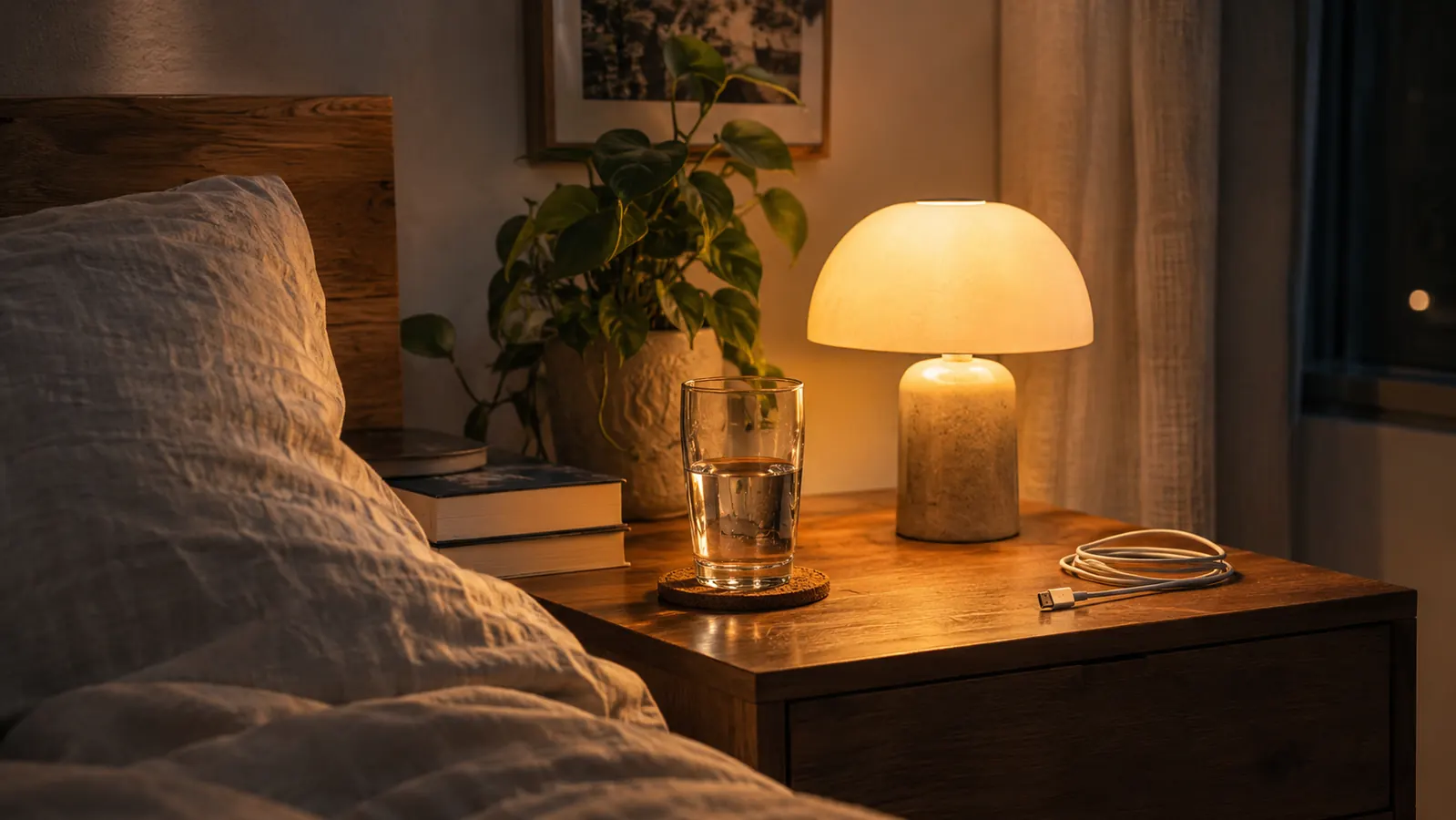
The bracelet is small and the battery is small with it. I charge mine on the cable it came with, on the kitchen counter, every few days. Not nightly. Every few days, which is exactly the kind of schedule a person forgets in the middle of three twelves in a row.
I forgot once. I had picked up an extra shift, slept through my alarm, grabbed the bracelet off the counter without looking at it, and it died somewhere around hour six. Daniel sent three taps that afternoon and felt nothing back. He did not mention it until I got home, which tells you something about how much the thing had already become part of his day.
Nothing about wearing it tells me the charge is running down. That is not a complaint, it is just true, and it is why I stopped relying on noticing. If you are the partner on the other end and the taps go quiet for a week, ask about the charger before you ask about anything else. That has been the answer every time in this apartment.
The fix is boring and it works. I put the charging cable next to the coffee maker. The bracelet goes on the cable while I make coffee on my first day off every stretch, and charging takes less time than the coffee does. Pick the object you touch at the same time every day and park the cable there. If you are the partner on the other end, this is worth asking about once a week, gently, rather than assuming the quiet means something.
Step 4: Wear It Where Your Job Won't Tear It Off
I work with my hands and my wrists end up in a lot of strange places. Gloves, gowns, rolling a stretcher, holding an IV bag above my head for four minutes. The bracelet is stainless steel on a braided cord, one size, and it has stayed on through all of it. But I had to find the right wrist and the right position under a sleeve, and that took about a week of trial and error.
I took it off for my first few shifts because I was worried it would catch on something. That defeated the purpose entirely. What worked was wearing it under the cuff instead of over it, and taking it off for showers, which is also the easiest way to lose track of where I put it down.
I tried my right wrist first, since I am right-handed and assumed the other side would stay out of the way. That was backwards. My right wrist is the one that ends up under gloves and against bed rails. My left mostly hangs there. It moved to the left on day five and has not moved since.
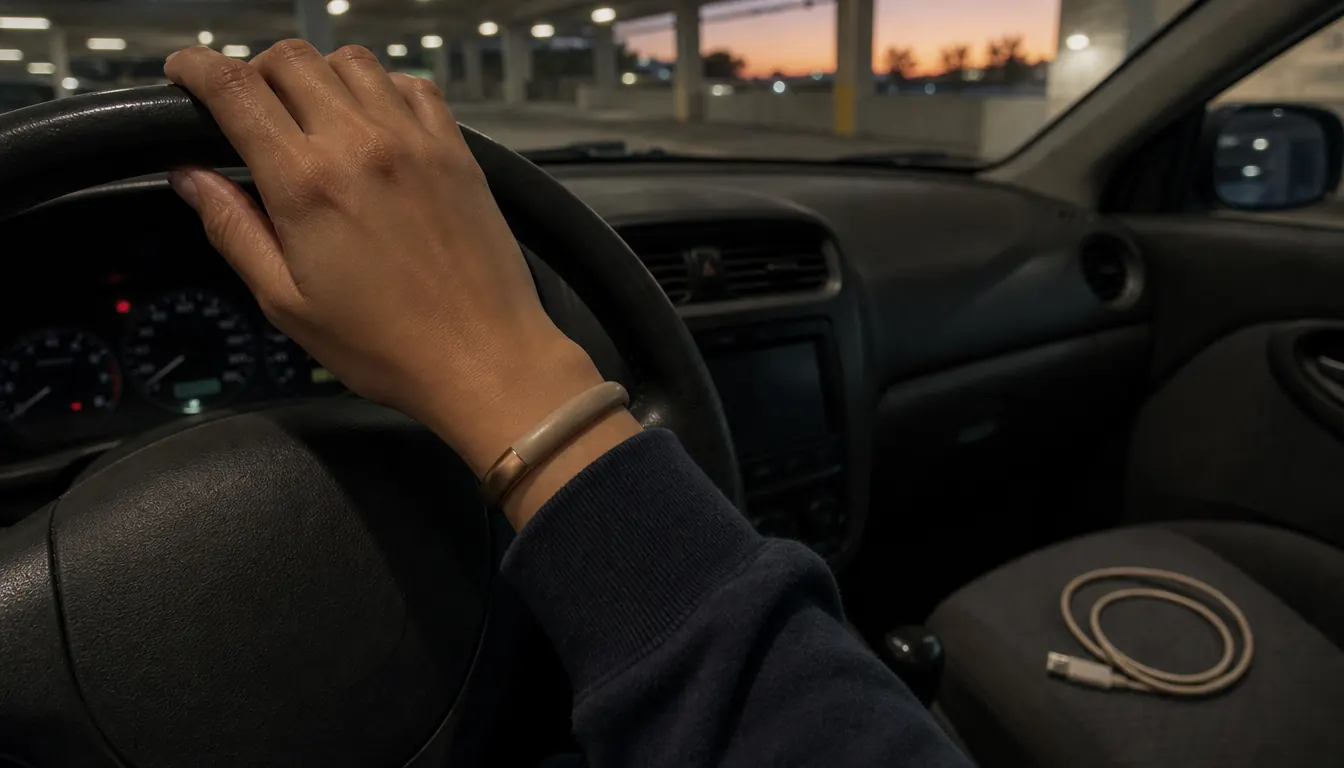
If your job makes a wristband a genuine hazard, do not force it. Wear it on the drive in and the drive home. Mine is twenty-two minutes each way and it is the quietest part of my day, which makes it a good place for the only four seconds of it that belong to Daniel.
Step 5: Tie the Buzz to a Specific Moment or It Fades
New things get used constantly for two weeks and then stop. I have done this with journals, with language apps, and with a gym membership I would rather not discuss. What kept the bracelets in rotation for eighteen months is that they are attached to moments in the shift rather than to a mood.
For the first two weeks I sent taps whenever I thought about it, which meant twenty in a row on a slow Sunday and nothing at all across three twelves. Daniel said the quiet stretch was worse than no bracelet, because he had started listening for it. Fixing a time fixed that. My phone alarm goes off at 6:38 with the label tap on it, so I stopped deciding whether to send one. It is the least romantic sentence in this article and it is the one that made everything else work.
Mine are 6:40, when I take my first break, and the walk to the parking garage at the end of the shift. Daniel's are when he sits down at his desk and when he leaves it. Two taps each. It takes four seconds, and it does not require either of us to be in a good mood or to have anything interesting to say.
That is the difference between a device you use and a device that becomes part of the day. The buzz is not carrying the relationship. It is carrying the fifteen hours between the end of one call and the beginning of the next, which is where long distance actually lives.
What Else Helps
The bracelet covers the middle of the day, the stretch when I am awake and working and Daniel is asleep, or the reverse. It is not the whole system. Our Friendship Lamp handles the other end. I tap mine when I walk in the door at 8 p.m. and Daniel's lamp in Portland glows, and he does the same when he turns in. Sunday night video calls get the box of conversation cards, a few at a time across about forty-five minutes. Letters to My Love is the slow one, a letter every month or two, handed over at the end of a visit or mailed. And the Aura frame on Daniel's kitchen counter gets photos from my phone a few times a week, usually from my walk home, because his apartment had almost no photos in it before.
If I were starting from zero with a partner on a rough rotation, I would buy the bracelet first and the rest later. It has the fewest steps between feeling something and sending it, and the fewest steps is the only metric that matters at 6:40 in the morning. Nothing on our list needs a subscription, which is worth checking before you buy anything in this category, since you are already budgeting for a flight every six weeks.
One tap means I am thinking about you. Two means I am okay. Neither one requires a reply, and that is the only reason I still send them at 6:40 in the morning.
The buzz takes four seconds. The silence it prevents takes longer.
Eighteen months of daily wear, one dead battery, zero regrets. TOTWOO Sun and Moon touch bracelets, paired through the free app, no subscription, charged on the kitchen counter every few days.
Amazon Check Today's Price on Amazon →