

Daniel and I have been long distance for three years. He is in Portland, I am in San Antonio, and the two-hour time difference means my Sunday evening is his late afternoon. For the first year we did what most couples do on video calls: we asked about work, we asked about dinner, we ran out of things to say, and we hung up feeling more apart than before. Fourteen months ago I bought a box of TALKING POINT CARDS, the 200-card couples deck, and put it on my coffee table next to my laptop. It changed the shape of our Sunday call more than any app we tried.
I am not going to tell you a card deck fixes a relationship. It does not. What it does is give two tired people a place to start when the usual small talk has run dry. The deck has 200 cards, 4 color-coded categories by depth, and no board, no timer, no complicated rules. You pull a few cards, you answer, you listen. That is the whole thing. Here are ten reasons it beats another round of 'how was your day' on a video call.
Give your next call a first question
The TALKING POINT CARDS box has 200 expert-written prompts in 4 color-coded categories, from light icebreakers to deeper questions. Keep it next to the laptop and pull three cards before the call starts.
Amazon See the 200-card deck on Amazon →10 Reasons the Cards Beat Small Talk
It gives the call a job besides catching up
A video call with no plan turns into a status report. Work, weather, dinner, done. The cards give the call a shape. I pull three or four before Daniel logs on, and we each answer one before we get to the week. The box says 20 minutes of estimated playing time, but we usually stretch a few cards across our 45-minute call. That small structure is enough to make the call feel like something we did together, not something we got through.
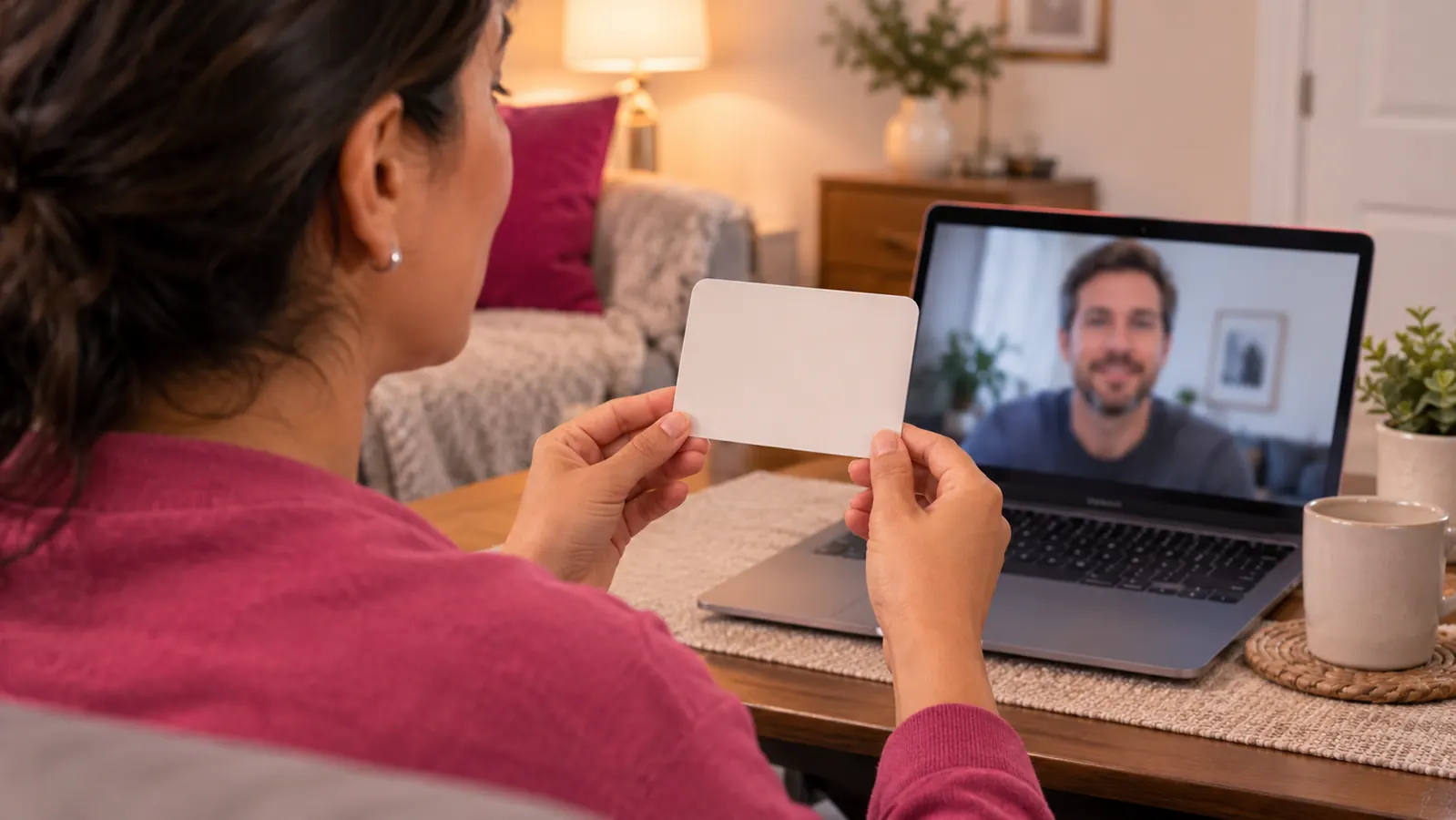
The four color-coded categories let you pick the depth in ten seconds
Some nights I want a light question. Some nights I want to talk about something real. The TALKING POINT CARDS deck sorts its 200 questions into 4 color-coded categories by depth, from casual icebreakers to deeper prompts. That matters on a call because you can read the room before you read the card. If Daniel has had a long day, I pick from the lighter end. If we have time and energy, we go deeper. I do not have to guess and neither does he.
A 45-minute call stops turning into a status report
Before the cards, our Sunday call had a rhythm: what did you eat, how is work, what is the weather. Useful, but flat. Now the middle of the call belongs to a question we did not write ourselves. The cards are written and reviewed by relationship and communication experts, which matters to me because I do not want a prompt that feels like a personality test. I want a plain question that opens a door. Most of them do.
It pulls out the stories you forgot to tell
Daniel and I have been together four years. We still learn things. A card about a childhood trip led to a story about his grandfather's truck that I had never heard. A card about a small win led to a work thing he had downplayed on text. The cards do not manufacture depth. They just ask for the story at a time when we are both sitting still and looking at each other. That is harder to do on a Tuesday night text thread.
Fourteen months in, the box still sits next to my laptop, and we still pull three or four cards on a Sunday call.
It works when one of you is too tired to invent a topic
I work twelve-hour shifts in an ER. Some Sundays I am running on coffee and not much else. Daniel can tell. The old version of me would have canceled the call or kept it to five minutes. The cards give us a low-effort way to stay on. I can pull a light card, answer in two sentences, and listen to him. The deck is manual, no board, no timer, no setup. That is the point. On a tired night, low effort is the difference between connecting and skipping.

The same box works on a video call and in person
We have brought the box on two visits. It fits in a travel bag, and at 350 grams it does not weigh down a carry-on. On a call, we hold a card up to the camera. In person, we pass the box across the table. The questions do not change, but the room does. Some of our best conversations have happened on a Sunday call and then again on a four-day visit, with the same card getting a different answer because we were in the same place.
It gets past the how was your day loop without forcing a heavy talk
There is a gap between small talk and a state-of-the-union address. Most couples live in that gap. The cards sit there too. They are not therapy prompts and they are not icebreakers for strangers. They are questions for two people who already know each other but have run out of new angles. If you want a light call, stay in the shallow end. If you want a real one, go one layer deeper. You control the depth, not the deck.
It gives quiet partners a turn without putting them on the spot
Daniel is quieter than I am. On a call, I can fill silence for both of us, which is not a good habit. A card changes the turn-taking. When it is his card, I have to wait. When it is mine, he listens. The deck is built for 2 players, so there is no group dynamic to manage and no one hiding in the back. It is just the two of you and one question. That structure gives him room to answer at his own pace.
The box is small enough to live on the coffee table and light enough to travel
I am not a person who keeps a game shelf. The TALKING POINT CARDS box sits on my coffee table next to my laptop, and it has stayed there for fourteen months. It is 350 grams, it fits in a purse or a travel bag, and it does not need a board, a timer, or a setup step. That sounds small. It is not. The best tools are the ones you do not have to remember to set up. This one is already where the call happens.
It builds a record of small things you can bring up later
The cards are not a journal, but they act like one. I remember which question got a long answer. I remember the story Daniel told about his first job. A week later I can bring it up on a text thread because it is already in my head. That is the quiet benefit. The call is not the only place the conversation lives. The cards give you material for the next call, the next visit, the next ordinary Tuesday.
What I'd Skip
I would skip any deck that starts with the heaviest question on card one. I would also skip a 500-card box with no categories, because you will spend more time sorting than answering. And I would skip any version that needs extra setup to work. The TALKING POINT CARDS deck works because it is a box of cards and a few minutes. If a product adds steps, it is not solving the problem, it is adding a new one. I can only speak to the one on my coffee table, but that one has earned its spot.
Your next Sunday call can start with a better question
The box has 200 cards, 4 color-coded categories, and a lifetime warranty against manufacturer defects. Pull three before your next call, put the laptop on the coffee table, and see what comes up.
Amazon See the conversation cards on Amazon →