

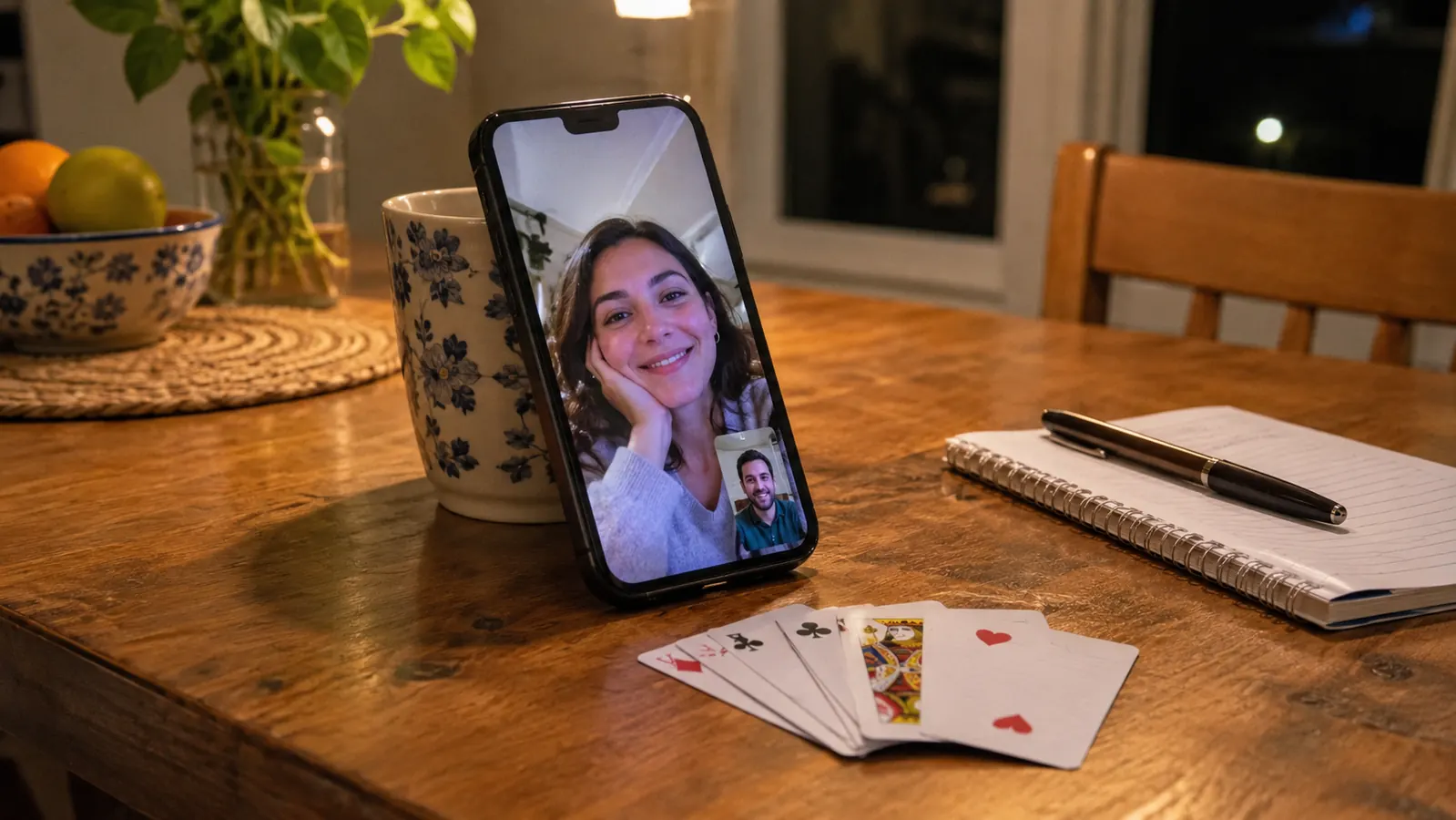
Sunday night is the only evening Daniel and I are both free, so the laptop sits open on my coffee table and we talk for about 45 minutes. Three years of Portland to San Antonio has turned that call into the closest thing we have to a standing date. Fourteen months ago I set a box of TALKING POINT CARDS next to the laptop, mostly because I was tired of hearing myself ask how his week went and getting a summary of a bridge project I will never understand.
Here is the short answer. I own the TALKING POINT CARDS deck and we use it most Sundays. I do not own We're Not Really Strangers. I have played a friend's set twice, in person, at her kitchen table, and I have read both listings and more reviews than I should admit to. My honest read: these two decks are not competing for the same spot on the shelf. One is a weekly habit for a couple who already lives together in every way except the address. The other is a sharper, more public facing deck that goes deeper faster and works just as well with friends. Which one you want depends on whether you are trying to fill a Sunday call for the next two years or crack something open in a single night.
| TALKING POINT CARDS | We're Not Really Strangers | |
|---|---|---|
| Cards in the box | 200 cards split into 4 color coded categories | Three levels in the core deck, with extra editions sold separately |
| How long it lasts you | Enough to draw a few per call for well over a year | Once you have been through the deck together, the surprise is spent |
| Playing it over a video call | No board, no timer, no rules. One person reads, both answer | Built around sitting across from each other in the same room |
| Deepest question in the deck | Goes deep in the last category, but eases you in first | Level three is the most direct set of prompts I have read |
| Couples with years of history | Written to work for new relationships and 30 year marriages alike | Leans toward discovery, which is thinner when you already know everything |
| Playing it with friends, not a partner | Couples edition, 2 players on the box | Works with friends and near strangers too |
| Giving it to someone who has never heard of it | Needs a sentence of explanation from you | The name does half the work for you |
| Packing it for a visit | 350 g box that fits in a purse or a travel bag | Small box, no complaints |
| Warranty | Lifetime warranty against manufacturer's defects | Nothing stated on the listing |
Where TALKING POINT CARDS Wins
Volume is the first thing. Two hundred cards, sorted into 4 color coded categories that move from light to heavy. At roughly four cards a call, which is what we average before one of us looks at the clock, that is a very long runway. The box lists an estimated playing time of 20 minutes and that matches what we actually do: a handful of cards, then we wander off into something else for 20 minutes, then one more card before we hang up. Daniel is not a game person. He tolerates games. He does not tolerate rules, and there are none here. No board, no timer, no scoring, no setup.
Second, it survives a video call. That sounds small until you try to play something with physical pieces across two time zones. The deck lives in a 350 g box that fits in a purse or a travel bag, and the whole thing works with one person holding the cards and reading out loud. We have also brought it on two visits, which is the other half of the test. A deck that only works on camera is a gadget. This one works fine on a couch.
Third, it is built for couples who are already in it. The listing says it works for new relationships and 30 year marriages alike, and the categories are the reason. The light end is safe enough to play after I have worked a 12 hour shift and have nothing left in the tank. The heavy end is where the good calls happen. There is also a lifetime warranty against manufacturer's defects, which is more than most paper products will offer you.

Where We're Not Really Strangers Wins
The deepest question in their deck is deeper than the deepest question in mine. We're Not Really Strangers is built in three levels, and that third level is the most direct set of prompts I have read in a card deck. A friend ran one on me in her kitchen and I had to take a second before I answered. If your goal is to get to the thing you have both been walking around in one sitting, their deck gets there faster and with less cushioning. Mine eases you in. Theirs does not, and for some couples that is exactly the point.
The second advantage is the name. If you are buying this for a couple you do not know well, or for a sibling who mentioned wanting to be closer to their partner, We're Not Really Strangers needs no explanation. People have heard of it. It shows up on lists, it photographs well, and the packaging reads as a gift without you writing a note explaining what it is. They also make editions meant for friends and near strangers, so one purchase covers a dinner party and a date night. TALKING POINT CARDS is a couples deck with 2 players printed on the box. That is the whole job, and it is a narrower job.
The deck that survives a Sunday call
200 cards, 4 categories, nothing to explain over video. This is the box that lives on my coffee table and still has cards left in it.
Amazon Check Today's Price on Amazon →How Each Deck Actually Plays on a Sunday Call
On our calls the mechanics matter more than the content. I hold the box. I pull a card, read it out loud, and we both answer. Daniel goes first because he thinks out loud and I need a second to land. If a card falls flat we put it in a separate pile and move on, and that pile has maybe a dozen cards in it after fourteen months. We're Not Really Strangers would technically work on a call too. The difference is that their deck is designed around two people in the same room, and you can feel that when you try to run it through a laptop screen. Mine was built to be read aloud, so the format travels.
First calls with a new deck are the tell. Mine went fine because the categories are printed so you can sort without reading every card first. I pulled from the lightest color for the first three and got a normal conversation out of it, which is all I wanted on a night when I had been on my feet since six in the morning. If you start at the heaviest color with someone who has had a long day, you will both end up performing depth instead of having it. The order is the feature.
There is also the matter of what the cards are for. My box is on the coffee table permanently. It is not an event. Nobody plans an evening around it. It sits there and one of us reaches for it when the conversation starts to sag, which usually happens around minute 25 of a call when neither of us has news. That is a different use case from a deck you bring out on a trip or open on an anniversary. If you want something that marks an occasion, either deck will do. If you want something that quietly rescues an ordinary Tuesday, this is the one that gets used.
One more thing about how it reads. The questions were written and reviewed by relationship and communication experts, according to the listing, and it shows in a specific way: the cards do not assume a problem. Some couples decks read like an intake form. This one asks what you would do with a free weekend, or what your partner was like at 19. Fourteen months in, my favorite cards have not been the heavy ones. They have been the ones where Daniel told me a story from before we met that I had somehow never heard.
Fourteen months of Sunday calls, about four cards a call, and we are roughly a third of the way through the box. Nothing else I have bought for this relationship has that kind of runway.
The Part Nobody Mentions: Repetition
Any deck has a shelf life and it is worth being honest about it. Two hundred cards sounds endless until you are 40 calls in. What saves mine is the categories. We do not work through the box in order. Some nights we stay at the light end because I am fried. Some nights we go straight to the heaviest color and stay there. I have answered the same card twice and given a different answer both times, which tells you something about the question.
The other half of repetition is physical. The box came on two visits and it lives on the coffee table the rest of the year. That is a lot of handling for something made of card stock, and it is holding up. No split corners, no cards fused together, nothing bent. I have knocked it off the table at least twice. The lifetime warranty is the kind of thing you never think about until you need it, and I have not needed it.
This is also where I would push back on the idea that a card deck can fix distance. It cannot. What it can do is take a call that was going to be a logistics check about flights and rental cars and turn it into 40 minutes you remember on a Wednesday. That is a small thing that compounds. It is the exact thing We're Not Really Strangers is good at, just at a different intensity. If your calls are already great, you may not need either deck. Mine gets used because our calls were fine and I wanted them to be better than fine.
Who Should Buy Which
Buy TALKING POINT CARDS if you are the person setting up a weekly call and you want something that will still have cards left in it next year. It suits couples with history, couples on a schedule, and anyone who has typed how was your day and gotten a one line reply back. It is also the safer gift for a couple you are close to, because there is nothing in it that feels like an ambush. Two players, 18 and up, 4 categories, no rules to explain.
Buy We're Not Really Strangers if the relationship is newer, if the two of you are comfortable being a little exposed, or if you want one deck that works with friends as well as a partner. It is the better gift for someone whose taste you are unsure of, because the name does the selling for you. What I would not do is buy it as a replacement for a standing weekly call with someone you have been with for years. That deck is built to open a door. Once the door is open you need something to walk through, and that is the part my box is for.
If you are shopping for someone else, the question is not which deck is better. It is which deck will actually get opened. A couple who texts all day and already knows the small stuff will get more out of the heavier deck. A couple whose main contact is one weekly call, which is exactly the situation I am in, gets more out of the one that works on camera with no setup and no props.
Start with the Sunday call
If the deck outlasts the call, it was worth it. Two hundred cards, four categories, and a box small enough to bring on the next visit.
Amazon Check Today's Price on Amazon →