
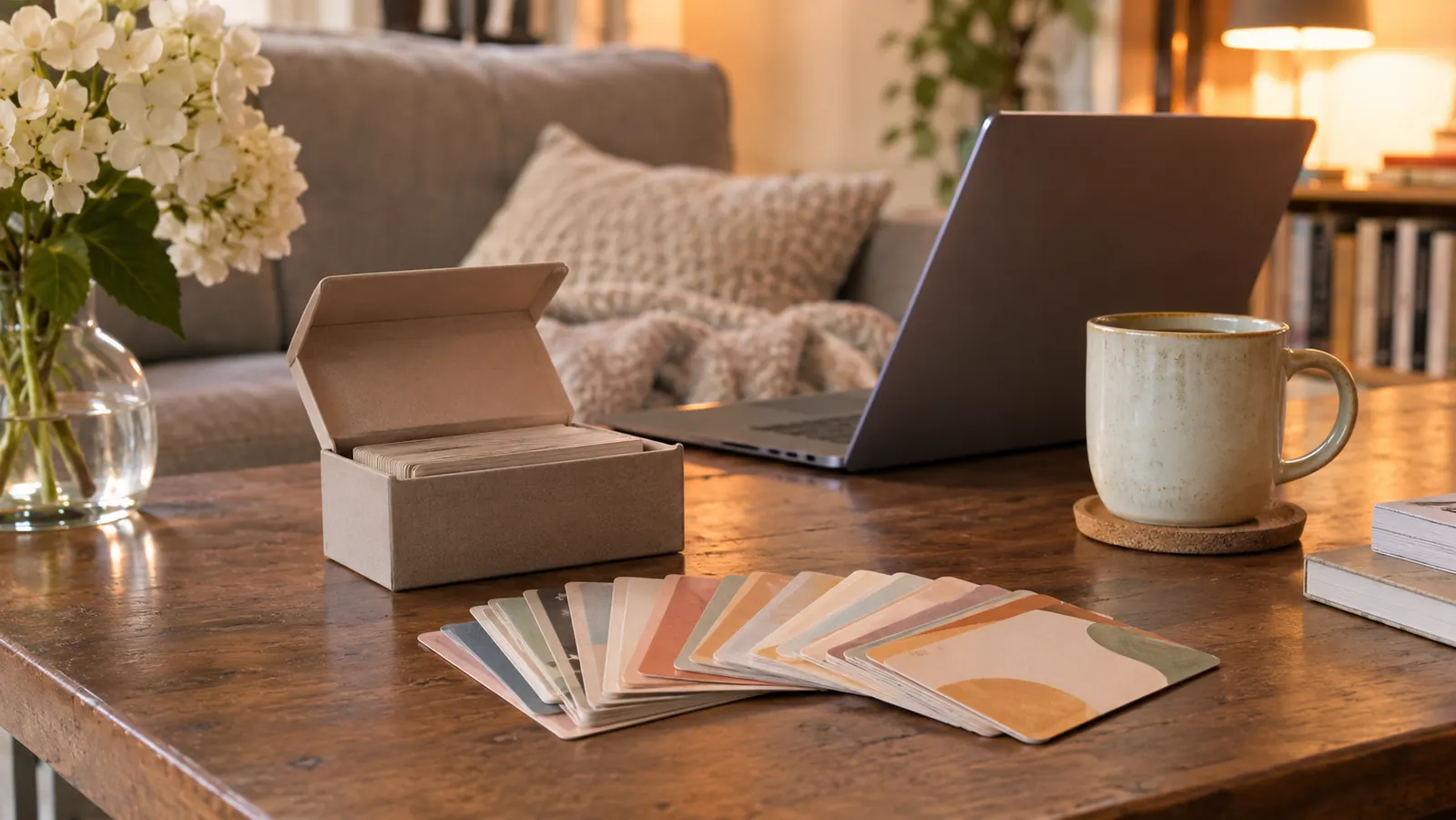
Daniel and I have run a Sunday night video call for three years, ever since his engineering job moved him to Portland and my twelve-hour shifts kept me in San Antonio. For the first two of those years, about forty minutes of every call was logistics. Flights. Who was flying in next. Whether his project deadline had shifted again. Whether my schedule had posted for the following month. The part where I actually felt like I had my partner back, instead of a very organized roommate two time zones away, lasted maybe ten minutes at the end.
Fourteen months ago I bought a box of 200 couples conversation cards from TALKING POINT CARDS and set it on my coffee table next to the laptop I take calls on. It was not a romantic gesture. It was a fix for a specific problem: our calls had turned into a status report, and I was tired of hanging up feeling briefed instead of close. I have used the cards on roughly one call a week since then, plus two visits, and I have a clear picture of what they do and what they do not do.
The Quick Verdict
The best weekly-call fix I have found for long distance. Portable, no app, no charging, and the questions are better than anything I would have come up with on my own. The deepest category is not for exhausted nights, and a few prompts fall flat. Still the best forty minutes of my week.
Amazon Check Today's Price →The box that ended our forty-minute logistics calls
200 cards, four categories by depth, no app and nothing to charge. This is the one that has lived on my coffee table for fourteen months.
Amazon Check Today's Price on Amazon →How I've Used It
The box lives on my coffee table, directly beside the laptop I take calls on, and it has lived there since the week it arrived. Sunday is my only guaranteed night off, so that is when Daniel and I call. The call runs about forty-five minutes. We do not work through cards for the whole thing. We usually get through three or four, sometimes five if the answers run short, and the rest of the call is just us being us, which is the point.
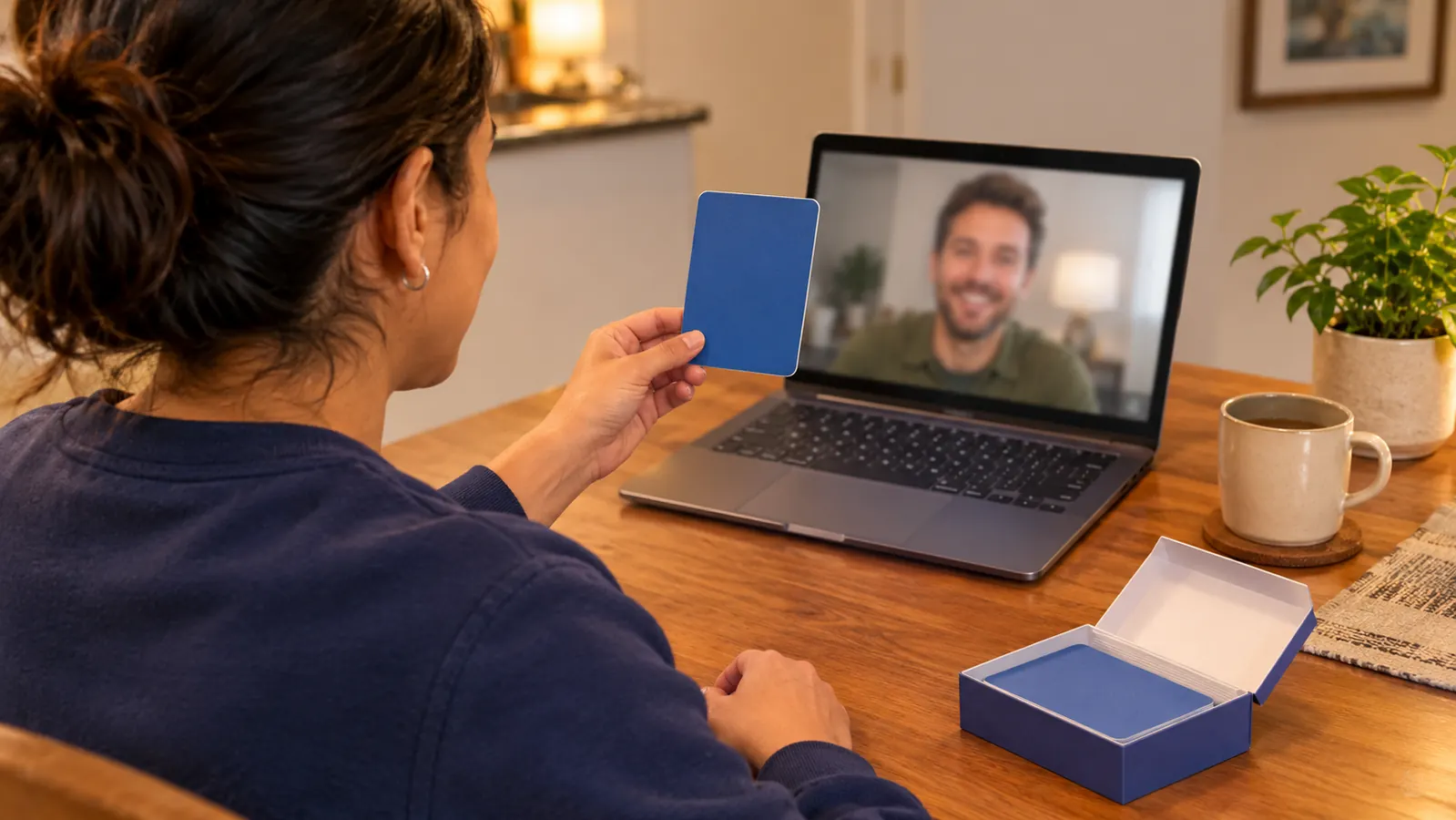
There is no scoring, no board, no timer, and no rulebook to argue about, which matters more than it sounds when one of us has been awake for eighteen hours. I shuffle, we alternate who draws, and whoever draws reads it out loud. The listing puts the estimated playing time at twenty minutes per session. That has been close to true for us on nights when we stick to a small handful of cards, and completely wrong on the nights when a single question eats half an hour, which happens more than I expected.
The first call with the deck is worth describing, because it is the one I almost called off. It fell on a Tuesday, not a Sunday, since my schedule had flipped and I had two days off midweek. I had about forty minutes before I needed to sleep and a box of cards I had not opened yet. We drew from the lightest category only, on purpose, because I did not want to open anything heavy with someone I had not seen in five weeks. We got through six cards in about thirty-five minutes. Two of them were nothing, the kind of question you answer in a sentence and forget. One of them, about a trip we took in our first year, kept us going for twenty minutes on its own. I remember hanging up and thinking the deck had done in thirty-five minutes what I had been failing to do for two years, which was get us past the schedule.
I also brought the box on two visits, one in July and one in February, and it changed shape in person. On the July trip we got through eight or nine cards in an evening on the balcony, partly because there is no lag and no screen between two people, and partly because a difficult question is easier to answer when you can see a face instead of a frozen thumbnail. The February trip was worse for cards and better for everything else. We were snowed in for two of the four days and did maybe three cards total, because when you are actually in the same room the silence stops being a problem that needs solving. My carry-on has a front pocket that fits the box with room to spare, so it has flown to Portland twice and come home twice, and the corners are still square.
What Is Actually in the Box
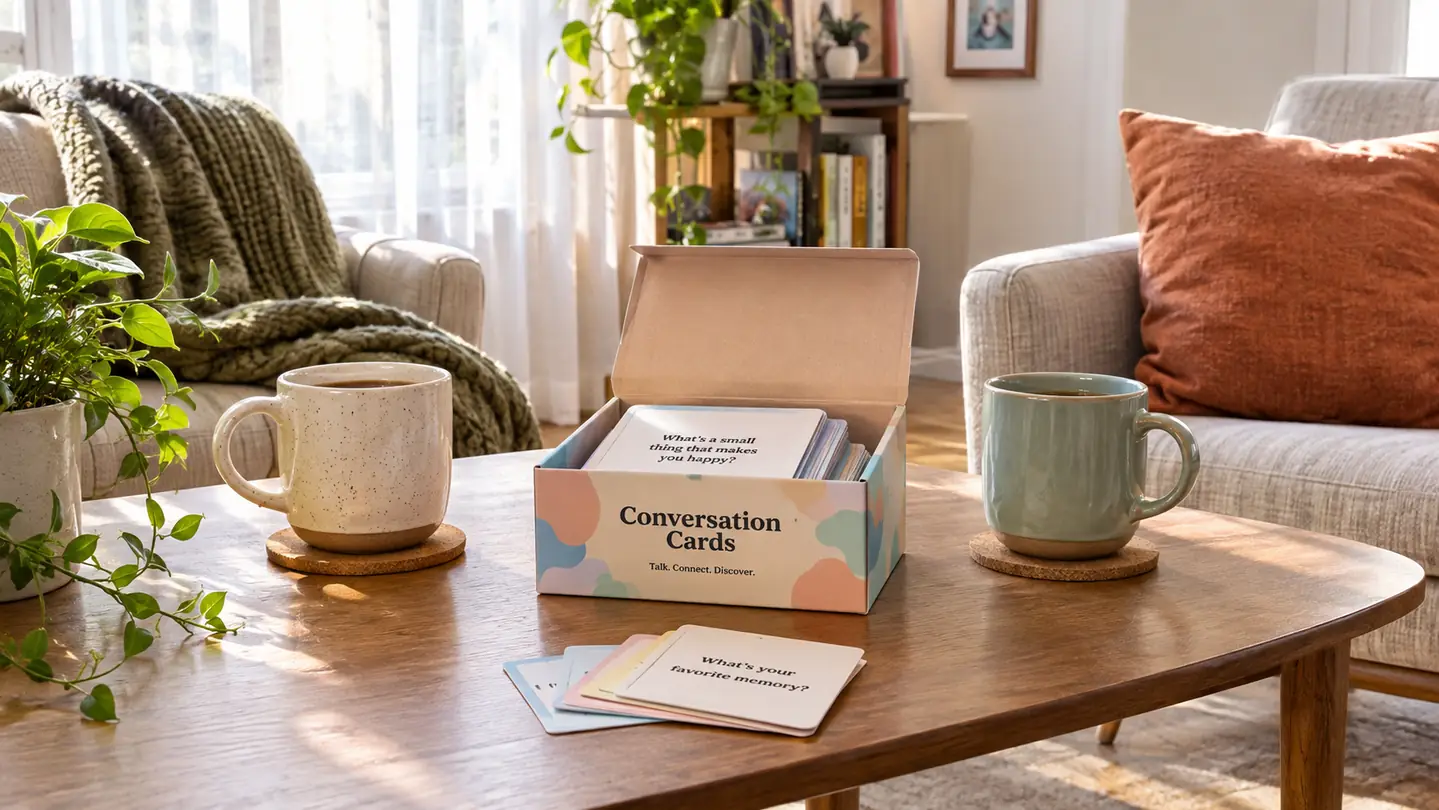
Two hundred cards, a small portable box, and that is the whole product. No app, no subscription, nothing that needs charging or updating, which is a genuine relief in a relationship that already runs on two phones, a lamp app and a bracelet app. The TALKING POINT CARDS deck is split into four color-coded categories, sorted by depth. The lightest category is icebreaker material you could ask a coworker. The deepest one asks you to say something out loud that you have been circling for a while.
The listing says every card was written and reviewed by relationship and communication experts. I cannot verify that from my living room, and I would not try. What I can tell you is that the questions are better built than the free lists I have scrolled through at two in the morning. They are specific. They ask about a decision you made, a fear you carry, a habit you want to break, not about how much you love each other. That distinction is most of the value.
The four categories are the part I underestimated before I bought the deck. In practice they function like four different evenings. The lightest is for a call when one of us is fried, and those questions are the kind you can answer while doing something else with your hands. The next one is about the relationship itself, how we met, what we remember getting wrong, what we would go back and redo. The third asks about the future, and for a long distance couple that category does an unusual amount of work, because the future is the thing we are actually negotiating every time we look at flight prices. You can pick the pile in about two seconds, which sounds trivial until you have spent a call opening with how was your week for the four hundredth time.
The set weighs 350 grams, roughly a paperback, and the listing puts it at two players, ages eighteen and up, in English, with a lifetime warranty against manufacturer defects. I have not needed the warranty. After fourteen months of weekly handling the cards are still flat, no corner is bent badly enough to annoy me, and the lid still closes. Nothing has been lost or damaged, and I have not had to replace a single piece of it.
How a Sunday Call Actually Goes Now
The shift was not dramatic. The first few weeks felt a little like a homework assignment, and we both noticed it and said so. Then it stopped feeling that way, mostly because the cards gave us somewhere to start that was not how was work. My job is not interesting to anyone who is not in it, and his involves spreadsheets and soil samples. A card would ask what we would do with a free weekend and no obligations, and twenty minutes later I would know something about his week that the logistics portion never surfaced.
One night in October sticks with me. I had worked three twelves in a row and I was horizontal on the couch with the laptop propped on a cushion, not really dressed for a call and not really caring. Daniel drew from the third category, the one about the future, and the question was something like where we pictured ourselves in five years. We had never answered that out loud. We had implied it, in the way you do when a conversation is expensive and there is never a good night for it. That call ran an hour and fifteen minutes, thirty minutes past our usual, and we used exactly one card. Nothing got resolved. But the shape of the thing we were both avoiding became visible, and we have brought it up a dozen times since without either of us having to raise it cold.
The categories do the work of matching the night. After a shift where I lost a patient, I am not drawing from the deepest pile. I pull from the lightest one and let the call be easy, and Daniel has gotten good at hearing it in my voice and doing the same without being asked. On a night when we have both had a decent week, we will go deep and stay there. Learning to pick the category was the actual skill here, more than the questions themselves.
The honest measure is what happens after we hang up. For two years I ended those calls with a summary of his week. Now I end them knowing what he is worried about, and there is a difference between those two kinds of knowing that three years of distance taught me to care about. Our calls did not get longer. They got specific.
Our calls did not get longer. They got specific. I hang up knowing what he is worried about instead of what he had for lunch.
Where the Deck Stumbles
Not every card lands. There is a small handful where I read it out loud, we both pause, and one of us says skip it, and we move on without ceremony. A few of the questions assume a couple with a shared household, shared furniture and a joint calendar, which is odd for a deck sold partly to long distance couples. Daniel and I own a lamp, a bracelet, a photo frame and a stack of letters. We do not own a couch together.
The deepest category also asks for energy I do not always have. That is not the deck's fault, but it is worth saying plainly: these are not passive cards you can flip through while folding laundry. Answering honestly takes attention, and on a night after a bad shift I have closed the box and put on a show instead. Fourteen months in, we still skip nights. The cards did not make our calls automatic. They just made the good ones easier to start.
There is one card I remember specifically, something about splitting household chores, and we both laughed and put it back. It assumed a kitchen we both use. Another asked about a tradition we had built together, and the honest answer was that we have not built any, because traditions need repetition and we get four days every six weeks. Those cards are not wrong to exist. They just land differently on a couple who has never signed a lease together, and after a year I have gotten good at spotting them from the first line and setting them aside before anyone has to answer badly.
There is repetition too. Two hundred cards is a lot, and we have not run out, but after a year of weekly draws we have hit the same question three times. It is a small thing, and the third answer was different from the first, which was interesting. It just means the deck is not infinite and eventually you will know it well.
The Objection I Had Before I Bought It
My first thought was that this was a product for people who cannot hold a conversation. I am an ER nurse. I spend twelve hours a shift asking strangers about the worst day of their year. I did not need help. What I had missed is that the problem was never that Daniel and I had nothing to say. It was that after three years of distance, the things we needed to say had gotten buried under the things we had to coordinate. A deck does not fix that by being clever. It fixes it by taking the first ten minutes of the call out of our hands.
The other objection was whether a stack of paper was worth it. I am not going to pretend the box is transformative. It is card stock in a small pack. What you are paying for is the editing, someone sitting down and writing 200 questions in order of difficulty and throwing out the bad ones. If that sounds like something you could do yourself, you probably could. I could have, and in two years of long distance I never did.
Who This Is For
Long distance couples whose weekly calls have gone flat or turned into scheduling. Couples who see each other every six weeks and need a bridge between visits. People like me, who are better at answering a specific question than at starting a conversation from nothing after a twelve-hour shift. It also makes a decent gift for a friend in a long distance relationship, though I would buy it as an add-on rather than the main gift, since the value only shows up once they actually use it. Nobody opens a box and feels close. The box just makes the next call easier, and for the person shopping, that is worth knowing before you hand over a TALKING POINT CARDS box and expect tears at the wrapping paper.
Who Should Skip It
Skip it if you want a gift that does the work by itself. This sits on a table until someone picks it up, and if neither of you is a card person it will sit there for a year. Skip it if your partner is uncomfortable with direct emotional questions, because the deep category is genuinely direct and there is no graceful way to fake an answer. And skip it if you already have a weekly call that works, with real content and no dead air, because you will find the icebreaker half tedious and you will be paying for questions you have already asked each other.
What I Liked
- 200 cards in four categories by depth, so you can match the deck to the mood and the energy of the night
- No app, no charging, no rules, nothing to argue about when you are both tired
- Small and portable at 350 grams, and it has traveled to Portland twice in a carry-on front pocket
Where It Falls Short
- A few prompts assume a shared household and land awkwardly on a long distance couple
- The deepest category needs energy you will not have after every shift
- After a year of weekly use you will start seeing repeats
If your Sunday call has become a status report
This is the one thing out of everything I have bought for the distance that changed what we actually say to each other. It sits on my coffee table, and it gets used every week.
Amazon Check Today's Price on Amazon →