
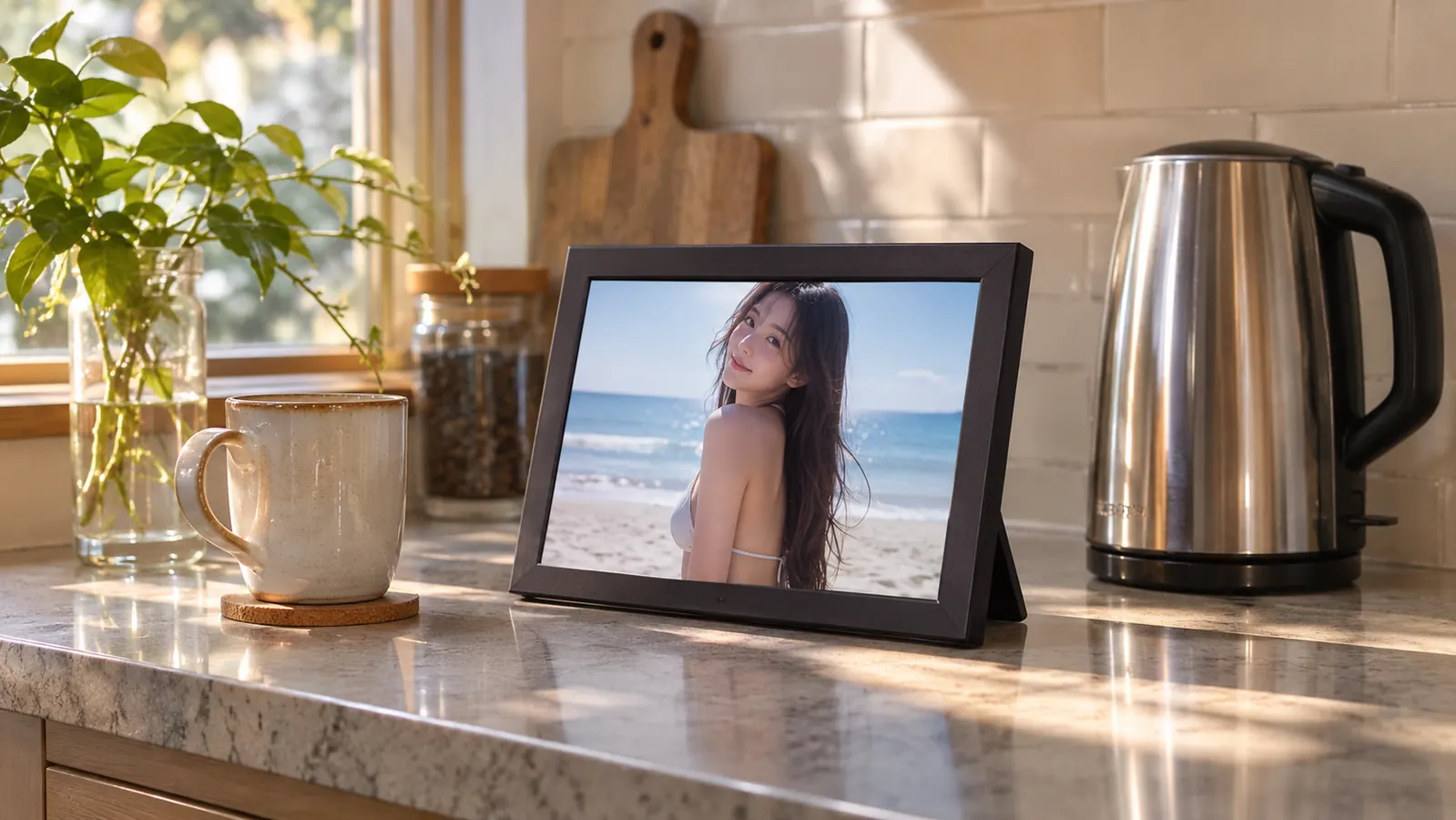
I bought the Aura Carver for Daniel's birthday in March, which puts this at the eight month mark. He lives in Portland, I live in San Antonio, and before the frame arrived his kitchen counter had exactly zero photographs on it. Not one. He is a civil engineer who moved into a one bedroom three years ago and has never hung a thing on a wall, so the gift was part practical and part stubbornness on my end. I wanted some evidence of my life sitting next to his coffee maker.
The short version is that it is a good frame and I would buy it again. The longer version is that it is a Wi-Fi device that lives on a cord, and those two facts shape the gift far more than any press quote printed on the box. AURA leads with the screen, which is fair, because the screen is genuinely nice. The requirements are the part you and your person have to live with afterward, and nobody puts the requirements in the gift description. So that is what this review is mostly about.
The Quick Verdict
A well built frame with a genuinely good screen that earns its place on the counter, provided there is an outlet and a router where it will sit.
Amazon Check Today's Price →The frame that has been sitting on his counter for eight months
A 10.1 inch screen, Wi-Fi, no subscription, one cord. If the outlet works and the router works, this is the easiest long distance gift I have given.
Amazon Check Today's Price on Amazon →How I've Used It, Two Time Zones Away
Here is the odd part. I have never really used the frame. It is his. What I use is the app on my phone, and what I do with it takes about ninety seconds, a few times a week, usually from my walk home or on a day off. I add photos the way I would send a text, except the text lands in his kitchen and stays there. That is the entire relationship I have with the product, and it has not gotten old in eight months.
The timing turned out to matter more than I expected. I work twelve hour shifts in an ER on a rotating schedule, so some weeks I am getting home at seven in the morning Central while he is still asleep two hours behind me. I send whatever I photographed that week, his kitchen gets it before he has had coffee, and by the time he is standing at the counter the frame has already changed. It is not dramatic. It is just reliably there, which is a different and better thing than dramatic.
There is a specific one I remember. The last Friday in May I came off a shift that ran long because a patient needed a second scan, and I walked out into a parking garage at 7:40 in the morning with the sky already bright and flat. I took a photo of my own shadow across the concrete because it was the only thing in front of me worth looking at. I sent it without thinking. Daniel texted back two hours later that it was the one showing when he walked into the kitchen, and that he had stood there with the kettle in his hand trying to work out what time I had gotten out. That is the whole product in one exchange. Not a slideshow. A small piece of information about my day that he would not otherwise have had.
I see the frame in person about every six weeks, for four days at a time, and I always look at it the way you look at your own handwriting on someone else's fridge. It currently sits between the kettle and the fruit bowl. It reads like part of the kitchen now rather than a gadget somebody was given, and I think that is the highest compliment you can pay a gift that has to live in a room.
The Screen Is the Least Interesting Thing About It
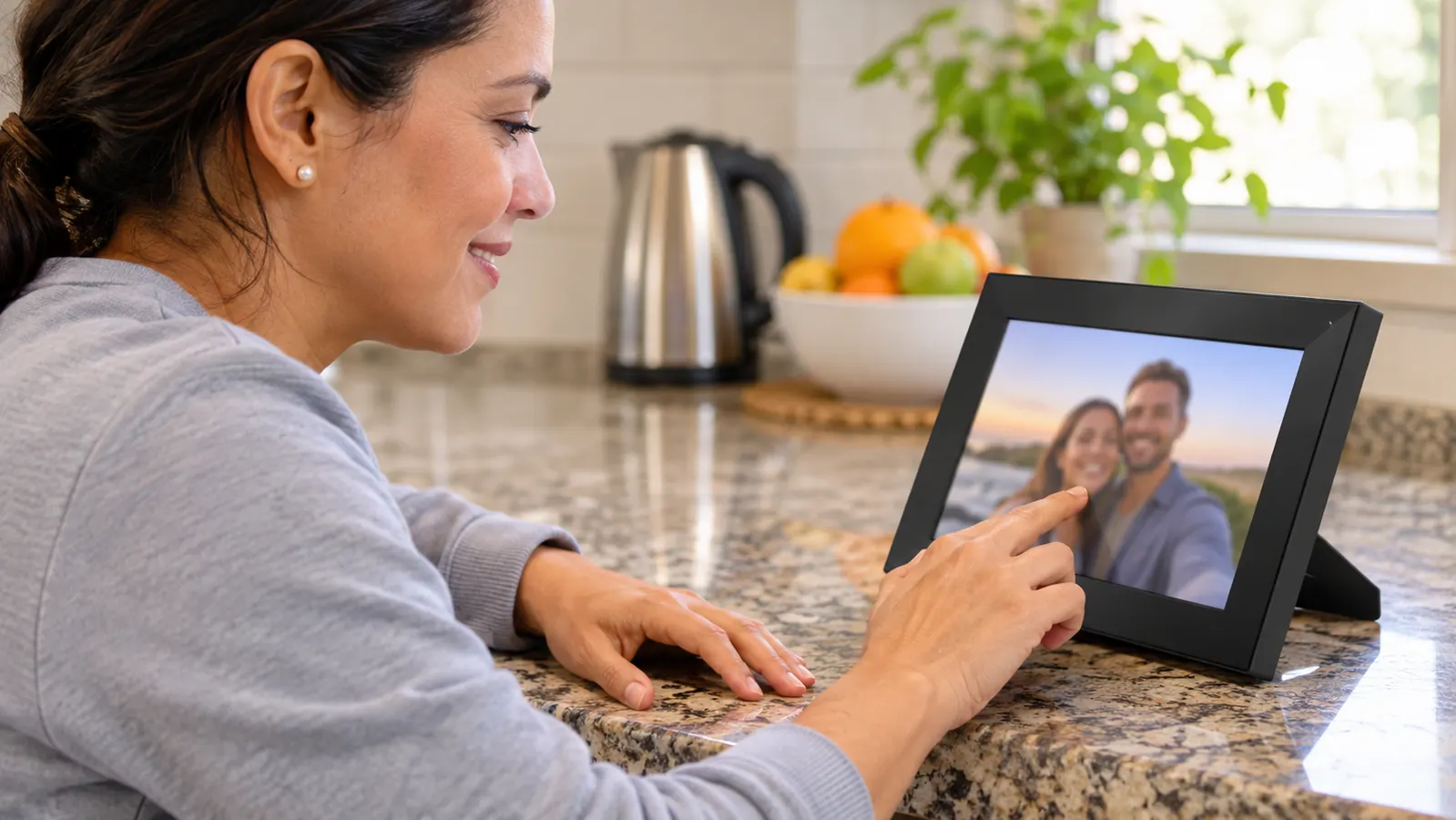
The listing says 10.1 inches, WXGA resolution, a 16:9 panel, and a touchscreen. What that means in a kitchen is that it reads like a small print on the counter, not like a television. Photos are sharp from across the room and sharp up close. The touchscreen works fine, and Daniel swipes back through older photos maybe once a week while he is waiting on the kettle. He is not interacting with it and he is not supposed to be. It is a window, not a tablet.
The 16:9 panel is the honest catch and it took me about a month to adjust. Phone photos are not shaped like a widescreen, so a portrait shot of me on a trail ends up with a lot of empty panel on both sides, and several of my early ones looked small inside a big bright rectangle. I learned to shoot landscape when I plan to send something. My first attempt at fixing this was cropping the portrait shots tighter in my phone before sending them, which mostly worked but made people look like floating heads. So I gave up on cropping and just started turning the phone sideways. If you mostly photograph vertically, expect to either crop or accept the margins. Neither is a disaster. It just changes how you choose what to send.
The frame body measures about 12.7 inches across according to the AURA listing, so budget roughly a foot of counter for it. In a small Portland kitchen that is real estate, and it is the reason the frame lives where it lives instead of over the sink, where I would have put it if the room had cooperated. I measured his counter on my phone during a video call before ordering, using the width of a cutting board as a reference, and came up with about fourteen inches of clear space next to the fruit bowl. That was close enough to be worth trying and not close enough to be sure. It fit, with the fruit bowl moved about two inches right.
The Two Requirements You Won't Find in the Gift Description
First, the cord. The frame is corded electric with no battery, so it goes where an outlet is, not where the light is best. Daniel's only free outlet was behind the coffee maker, which meant moving the kettle about six inches to the left and accepting a cable you can see if you look for it. In a kitchen he has not renovated, that was fine. In a rental with outlets in strange places, the frame will pick its own location and you will not get a vote.
Second, the Wi-Fi. When his internet dropped for an evening last month, the frame did not go dark. It simply stopped changing. The last photos stayed up, which is honestly the right behavior, but nothing new arrived until the router came back. If you are picturing a gift you can hand to someone in a house with no home network, this is not that gift, no matter how many reviews call it easy to set up. Easy to set up and possible to set up are two different claims.
The drop taught me something useful, which is that I now check before I send anything I actually care about. He texted me on a Tuesday night to say the internet had been out since he got home, mostly so I would not think he was ignoring the photos. I had sent four that afternoon from a walk along the river, all of them good ones, and they sat in the app until his connection came back the next morning. Nothing was lost. But for eleven hours I had no idea whether what I sent had landed, and there is a small specific anxiety in that which I did not anticipate when I bought a picture frame. It resolves itself. You just learn not to attach meaning to the delivery timing.
Neither of these is a defect exactly. They are the terms of the thing. I mention them because the frame I imagined before I bought it was some kind of floating magic window, and the real one is a small screen plugged into a wall that talks to a router. Once you accept that, everything else about it is pleasant, and the list of things that can go wrong shrinks to two items you can check before you buy.
The Part I Underestimated
I expected him to like it. I did not expect it to become background. In week one he texted me a photo of the frame showing a photo of us, which is a very Daniel thing to do. By month three he had stopped mentioning it at all. That sounds like a downgrade and it is actually the compliment. It became furniture, and furniture is the goal with a gift like this, because furniture is the thing that is still there in year two when the novelty is long gone.
There is no subscription, which matters more to me than the screen quality if I am being honest. Everything the frame does, it does on the purchase, and nothing renews. I have a real allergy to gifts that quietly turn into a monthly bill attached to the person I love, and this one never did. Nothing has ever popped up asking me to upgrade to see my own photographs, and after eight months I trust that.
The one feature I used and then failed to appreciate at the time: you can preload photos, videos and a short message before you give the frame away. I filled it before his birthday, so it was already showing our first trip together when he plugged it in. It took me closer to an hour than twenty minutes, because I kept stopping to look at things, and I rewrote the message four times before leaving it alone. Unwrapping a frame that is already full is a much better moment than unwrapping one that asks you to set it up first. If you are buying this as a gift, do that part. It changes the whole handoff.
What Daniel Says About It, Eight Months In
I asked him directly for this review, because it is his kitchen and his counter. His answer, near enough to verbatim: he notices it most in the morning, he likes that it changes without him doing anything, and he has never once had to fix it. He also said he would not have bought it for himself, which is the entire reason it worked as a gift. Some people will not buy the thing that makes their apartment feel less temporary.
His only complaint is the same as mine, and it is about placement rather than the frame. The cord dictated the spot. He would have put it on the shelf by the window where the light is better, and instead it is next to the kettle where the outlet is. That is a small thing that a person living alone in a rental will notice every day for a year.
Eight months, roughly a hundred photos, and the frame has never been the thing that went wrong. It just sat there and showed him my week.
The Annoyances, In Order
The cord is number one, and I have already made my case. It is a permanent visible cable in a room where you might not want one, attached to a device that cannot be moved to the spot with the better light.
Number two is how much I think about what to send. The frame is passive and I am the one making every decision, so there is a low hum of have I sent anything this week that did not exist when the photos were just sitting in my camera roll being ignored. It is a pleasant obligation, but it is an obligation, and if the person adding photos is already running on fumes after twelve hour shifts, that is worth saying out loud before you buy.
Number three is the reviews themselves. The frame sits at 4.7 stars across more than fourteen thousand ratings, and before I bought it I read the one star ones first, the way I always do. Most of them were connectivity complaints, frames that would not stay on a network. Mine has not done that in eight months. I cannot promise yours won't, and I would rather tell you that than pretend a rating is a warranty. There is a one year warranty, for what it is worth, which covers the hardware and not the router.
What I Liked
- Photos land in another time zone in about a minute, with no fuss on either end
- Sharp 10.1 inch screen that reads clearly from across a kitchen
- No subscription, so the gift never quietly becomes a bill
- Preloading photos and a message before you give it makes the handoff
- Simple enough that a person who ignores most gadgets has never asked me for help
Where It Falls Short
- Corded only with no battery, so an outlet decides where it goes
- The 16:9 panel leaves wide margins on portrait phone photos
- Completely dependent on home Wi-Fi
- Someone has to keep sending photos, and in our house that someone is me
Who This Is For
This is for the person in a long distance relationship who has a router, a spare outlet, and one permanent surface where a small screen can live forever. A counter, a nightstand, a shelf by the door. It suits people who already send each other photos and want them to stop disappearing into a chat thread. It suits anyone who wants a gift with no ongoing cost attached, and it suits the sender who is willing to spend ninety seconds twice a week feeding it. That last part is not a technical requirement, but it is the difference between a frame that stays alive and one that shows the same six pictures from March until someone gets bored. AURA has built something that is genuinely hard to mess up once it is on the network, and that is most of the battle with a gift like this.
Who Should Skip It
Skip it if the recipient has no reliable home internet, because a frame that cannot receive photos is an expensive clock. Skip it if there is no free outlet where the frame would actually sit, since the cord will not negotiate. Skip it if you want a gift that asks nothing of you after the handoff, because this one asks for a steady trickle of small effort and it stops being meaningful without it. And skip it if you want a wall hung gallery of prints, because this is a counter object with a plug, and no amount of good design changes that.
If I Were Doing It Over
I would buy the same frame and I would do two things differently. I would check for a free outlet before I ordered, rather than after, and I would ask whether the kitchen counter actually has a foot of space going spare. Both of those are five minute questions that would have saved a rearranged kettle. Everything else I would repeat, including filling it with photos before I wrapped it. Eight months later, with a visit every six weeks and two time zones in between, it is the gift in our apartment that gets used the most and discussed the least.
A gift that is still changing his kitchen eight months later
One cord, one router, no subscription. If both of those exist at your person's place, this is the frame I would buy again.
Amazon Check Today's Price on Amazon →