

Sunday night, 9:40 in San Antonio, 7:40 in Portland. I had spent twelve hours on my feet in the ER and I had exactly enough left in me to eat cold leftovers and stare at a screen. Daniel called at his usual time. And for roughly the two hundredth time in three years, we ran the same script. How was your day. Fine. Busy. What did you eat. I don't remember. Then a long pause while we both pretended to be very interested in our own laptops.
That pause is what long distance actually does to a couple. It does not usually blow up. It goes quiet. You run out of new things to report because nothing new happened, and the call turns into two people reading the news at each other for an hour. Fourteen months ago I bought a deck of 200 conversation cards for couples, TALKING POINT CARDS, mostly because I did not want to spend another Sunday pretending my day had been interesting. The box lives on my coffee table next to my laptop. Its job is one call a week. This is the plan we built around it, in the order I would do it again.
Your call does not need more minutes. It needs something to answer.
Two hundred cards, four categories sorted by depth, no board and no rules to learn. Ours has sat on the coffee table for fourteen months of Sundays.
Amazon Check Today's Price on Amazon →Step 1: Pick One Night and Protect Forty Five Minutes
Ours is Sunday. Not Friday, because Friday night should feel like a night out even when it is a night in, and not Monday, because Monday is already a chore. Sunday is a little melancholy by default. A good call is the cheapest fix for that I know.
Forty five minutes, with an end time. This matters more than it sounds. The two hour call that runs until one of you is falling asleep ends with both of you faintly irritated and nothing to show for it. A timed call ends while you still like each other. I check my rotation two weeks out, pick the Sunday that does not sit right after a night shift, and put it on the calendar with both times in it, because two time zones means two clocks and I have gotten that wrong more than once.
What the night replaces is the default check in, not the texting. We text all day. That was never the problem. The call was the part with no shape to it. Once a week got a shape, the other six days got easier, because I stopped saving things up for a conversation that never quite happened.
Then protect it. I have moved this call for a coworker's birthday and for a shift swap, and I have not moved it for a load of laundry. Daniel has done the same on his end. That sounds rigid for something so small. It is the only reason it is still happening three years in.
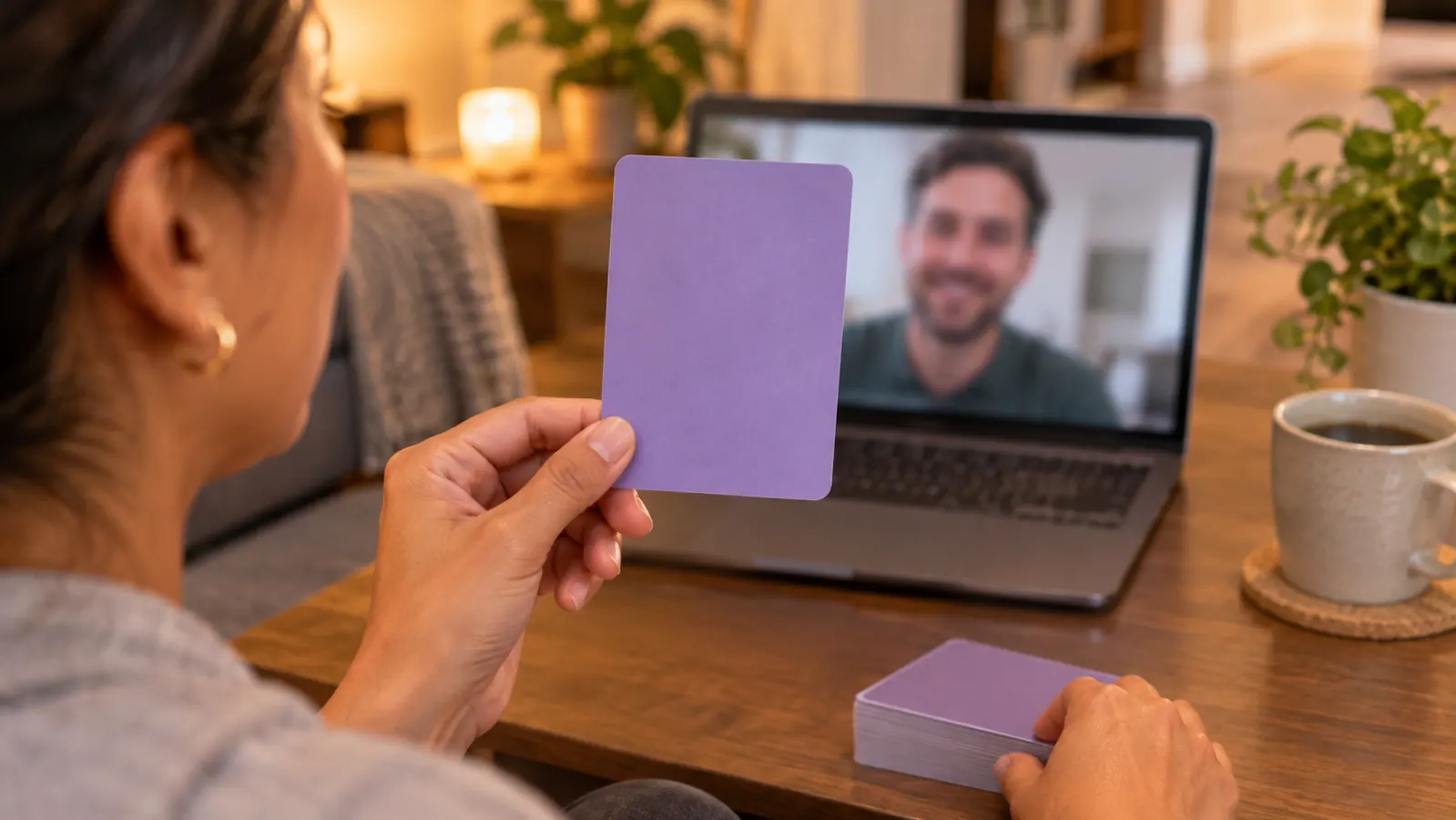
Step 2: Fix the Lighting Before You Fix the Conversation
This sounds like the boring part. It is the part that decides whether the call feels like a visit or a hostage video.
Two things. Put the laptop on something so the camera sits at your face instead of your chin, a stack of books is fine. And put a lamp in front of you, not behind you. Daniel spent most of our first winter apart as a silhouette against a Portland window at 7 pm, and I spent most of mine lit from below by a screen, which is the least flattering light on earth. We fixed both in the same week and the calls got noticeably better, which is a strange thing to say about light.
Headphones on, phone face down, laptop on the coffee table with the card box beside it. If you have thin walls, headphones also let you talk at a normal volume instead of the half whisper that makes every conversation feel like a negotiation.
One more, and this is a preference not a rule: do not take the call in bed unless you both are. One of you horizontal and half asleep sets an odd tone for a card that asks something real.
Step 3: Deal Three Cards, Not the Whole Box
The box holds 200 cards in four color coded categories, sorted by depth from easy openers to the ones that take a minute before you answer. The listing says about twenty minutes of play. On our calls three cards usually runs closer to thirty, because one of them always does.
The way we do it: each of us draws, we take turns reading our own card out loud, and neither of us reads it in a game show voice. No scoring. There is no board, no timer and no rules to learn, which is the reason the TALKING POINT CARDS box survives a night when I have been on my feet for twelve hours.
Pick the depth on purpose. If I came off a shift, we stay in the lighter two categories and let the call be funny. If one of us has had a hard week, or a visit just ended, we go to the deeper ones. Drawing a deep card because the calendar says so, on a night when one of you has nothing left, is how you get a forty minute silence and a bad taste.
Do not try to do the whole box. We tried that once on a visit, sitting on my floor with takeout containers, and we got to about card forty before we were both giving one word answers. Two hundred cards is not a challenge. It is a supply.
And if you draw a dud, which happens, say so out loud and draw again. Nobody has to be a good sport about a question that does not fit the week you are having.
Forty five minutes, three cards, one night a week. Fourteen months in, we have never ended a call with nothing to say.
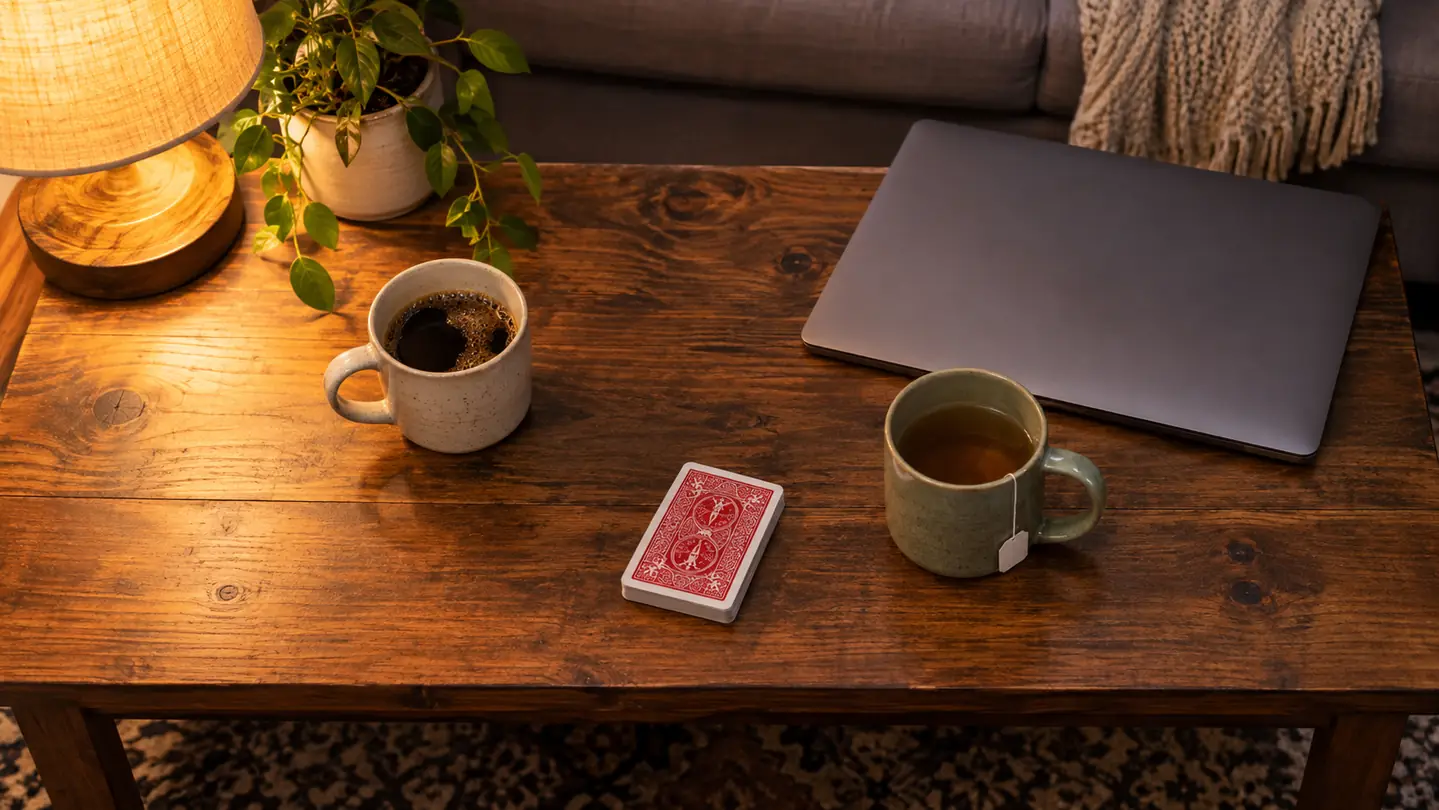
Step 4: Take Turns and Let One Card Run Long
The mistake I made early was treating the cards like an interview. Read, answer, next. That gets you through the box and nowhere else.
The useful part is the follow up question. One of the deeper cards asked us something about the year ahead, and we spent twenty minutes on it, most of that on a plan for a Saturday in a city neither of us lives in. That conversation did more for us than the previous month of daily texts. It is not the card itself. It is the twenty minutes the card buys you.
So let it run. If Daniel answers a card and I want to know more, I ask, and we drop the plan of getting through three. Two cards and one long answer beats five and a brisk nod. And if an answer is short, let it be short. Some cards are for a shrug and a laugh and that is a fine outcome.
The other thing I would say is do not use a card as a crowbar. If there is something real going on between you, a card that happens to touch it will feel like a trap, and then the deck becomes the thing you both avoid. We had one call where a card landed on a sore subject and it went badly, and the fix was to close the box and just talk about it, not to draw another.
The cards were written and reviewed by relationship and communication people, which shows in how the deeper ones are worded, but no card knows what week you have had. You do.
Step 5: End the Call on Purpose
Long distance calls rarely end. They fade. One of you says well, and then there are ten more minutes of nothing, and then someone's battery dies. That fade is where the sadness gets in.
Our ending is fixed and slightly ridiculous. Last card is a light one. Then the next visit gets named with a date, even if the flights are not booked yet. Then goodnight, and the lamp on my nightstand switches to his color, which is how he knows I am actually done for the night and not just saying it.
Ten minutes of a call spent saying nothing is worse than hanging up while it is still good. Ending on a card gives you a clean place to stop, which sounds like a small thing until you have spent three years trying to find one.
The card also does a second job. It gives you something to text about on Tuesday. Half our weekday messages now start with a follow up to something one of us said in the last card, and that is a much better Tuesday than what we had before.
Then put the box back on the coffee table, not in a drawer. A deck that lives in a drawer gets used about four times. A deck in the middle of the room gets picked up.
What Else Helps
The TALKING POINT CARDS deck carries one night a week. It is not the whole system, and I would not pretend a box of questions fixes a three year distance on its own. Here is the rest of what is actually on our nightstands and counters, and what each thing is for.
The Friendship Lamp, a set of two, one on my nightstand and one on Daniel's, bought two years ago as a Christmas gift. Its job is the end of a shift and the goodnight, nothing more. It runs on Wi Fi through its own app and it does not make a true white light, so it is a signal, not a reading lamp. When I come off at eleven at night I touch mine and his switches to my color, and he knows I got home. That is the entire function and it is worth more than it sounds.
The TOTWOO Sun and Moon touch bracelets, bought eighteen months ago for our anniversary. I wear the Sun, he wears the Moon. Mine buzzes when he touches his, which mostly happens in the middle of a shift when I cannot look at my phone. It pairs through a free app with no subscription. I take it off for showers and charge it on the kitchen counter every few days. I forgot once before a shift and it died halfway through, which I noticed.
Letters to My Love, the Chronicle Books one, bought a year ago in the fall. Only I write in it. I fill in a letter, seal it, and hand it to Daniel at the end of a visit or mail it. I have done a handful so far, not all twelve. Its job is the slow handwritten thing that is not another text, and it is the only item on this list that gets better the less often it happens.
The Aura Carver 10 inch frame, bought eight months ago for Daniel's birthday, sits on his kitchen counter in Portland. I add photos from my phone through the Aura app, a few a week, usually from my walk home or from a day off. His apartment had almost no photos in it before. No subscription. I only see it in person on visits, which is its own strange thing.
And what did not work, so you can skip it: cards on a weeknight after a shift, doing the whole box in one sitting, and any attempt to use a card to open a conversation that needed to be opened directly. None of that is the deck's fault. All of it made me less likely to reach for the box the following week.
One box, one night a week, and something to actually answer.
200 cards, four categories sorted by depth, about twenty minutes of play, and a box small enough for a purse or a carry on. Fourteen months of Sundays and it still comes out on the coffee table.
Amazon Check Today's Price on Amazon →